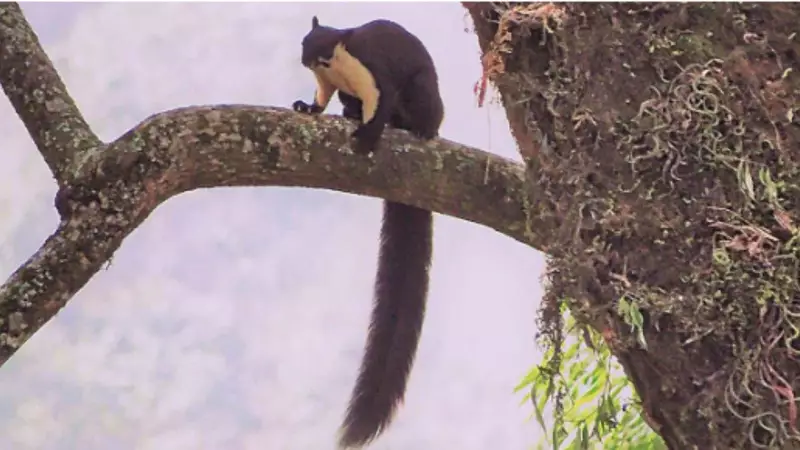
In a promising sign for local biodiversity, Maharashtra's state animal, the Indian giant squirrel, was officially sighted during a major wildlife survey in the Pune forest division. The elusive creature, locally revered as Shekru, was documented by forest staff, highlighting the ecological vitality of the region's woodlands.
A Rare Canopy Sighting During Tiger Census
The significant encounter occurred on January 5, 2026, at around 7:45 am. Forest guard Ganesh Mehetre and forest ranger Krishna Dethe recorded the sighting along a transect line near Tiger Point in Atwan village, within the Lonavala range. They were conducting census work for the All India Tiger Estimation 2026, which has been active across all forest ranges of the division since the first of January.
Amid the methodical work of checking camera traps and walking transects, a sudden movement of brown and black high in the forest canopy captured their attention. The sighting of the vibrantly colored, arboreal mammal provided a welcome diversion and a crucial data point about the forest's health.

Shekru: An Indicator of Pristine Forests
Mangesh Madhukar Tate, the Assistant Conservator of Forests, emphasized the importance of the discovery. He explained that the Indian giant squirrel, or Malabar giant squirrel, is typically found only in dense, evergreen forests rich in flora and fauna. Its presence is a strong indicator of a healthy, resource-rich ecosystem capable of sustaining complex wildlife.
"You do not see them easily in degraded habitats," Tate stated. "Their presence indicates that the forest has the necessary resources to sustain complex wildlife." The species is arboreal and elusive, playing a critical role in forest regeneration by dispersing seeds. Sightings in the Pune division are relatively rare, with more frequent reports usually confined to remote Western Ghats sanctuaries like Bhimashankar.
Broader Implications for Conservation
The ongoing tiger estimation survey is designed to track multiple species, not just tigers. Recent observations in the area have also included mouse deer, sambar deer, and various signs of tiger activity, collectively painting a picture of a biodiverse and ecologically functional region.
Tate used the occasion to underscore that conservation is a collective responsibility extending far beyond the forest department. He pointed to increasing pressures from urbanisation, superstition, and hostility toward wildlife as major threats to natural habitats.
"Protecting forests is a fundamental duty," he asserted. "Conservation begins with awareness and simple steps such as growing trees, reporting harm, and remembering that the natural world is not merely a playground for humans."
While the Indian giant squirrel is currently listed as 'Least Concern' on the IUCN Red List due to its wide distribution and large population, its distribution is often fragmented because it cannot tolerate habitat degradation. Therefore, its presence in the Pune forests is a positive ecological marker. More detailed findings on the overall health of wildlife and habitats in these forests are expected as the next phase of the comprehensive survey concludes.