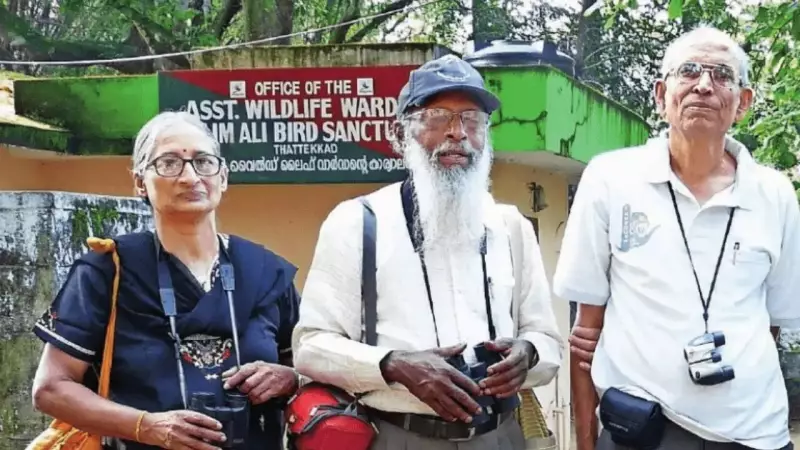
The story of Indian ecology is incomplete without the towering figure of Madhav Gadgil. A scientist, teacher, and relentless fieldworker, Gadgil championed a revolutionary idea: forests cannot be saved by government decrees alone, but by listening to the people who live within them. This philosophy shaped his life's work and continues to challenge India's approach to environmental management.
A Foundation Built in the Field
Dr. V.S. Vijayan, a close associate, recalls his first meeting with Gadgil in 1975 at the Ranganathittu Bird Sanctuary in Mysore. The encounter set the tone for their future collaborations. They later worked together at the Centre for Ecological Sciences (CES) in the Indian Institute of Science, Bengaluru. In those early days, without an institutional vehicle, they traversed the landscape by bus, conducting extensive fieldwork. Their joint efforts were instrumental in designing the Nilgiri Biosphere Reserve, which successfully integrated the Bandipur, Mudumalai, and Wayanad sanctuaries across Karnataka, Tamil Nadu, and Kerala. This reserve was eventually declared under UNESCO's Man and Biosphere programme.
The Western Ghats Battle: A Report That Shook the System
Gadgil's most significant and contentious contribution came when he was appointed chairman of the Western Ghats Ecology Expert Panel (WGEEP) in 2010 by then Environment Minister Jairam Ramesh. The 14-member committee, which included Dr. Vijayan, worked intensively for a year and submitted its report in 2012. However, a change in ministry leadership led to the report being shelved until public pressure forced its release.

The WGEEP report recommended that 73% of the Western Ghats be declared Ecologically Sensitive Areas (ESAs), with only 27% as protected areas. It provided a detailed zoning system (ESA 1, 2, and 3) with clear guidelines on permissible and prohibited activities to ensure sustainable development. The government found these recommendations unacceptable. Subsequently, a new committee under Dr. Kasturirangan was formed, which controversially flipped the recommendation, proposing 73% for development and only 27% for protection.
Belief in People Over Politics
Faced with political resistance, Gadgil chose a different path. Instead of futile arguments with leaders, he took his findings directly to the communities. He presented the WGEEP recommendations to a panchayat in Maharashtra's Sindhudurg district, which unanimously resolved to implement the report in full. This action perfectly reflected his core belief: evidence-based dialogue with local people is more powerful than top-down political persuasion.
This approach, however, also met with fierce opposition, particularly in Kerala. Misinformation campaigns, some led by church groups, spread fear that the report would evict people, ban farming, and deny housing rights. During one visit to Idukki district, Gadgil and his team were blocked at Thodupuzha. On another occasion, he received threats of physical violence, with warnings that his legs would be broken if he entered the area. His response was characteristically calm and defiant: "I am not cancelling my trip. If they break my legs, let us see." The government was eventually forced to provide him with full police protection.
Beyond the serious ecologist was a man with a hearty appetite and deep humanity. Dr. Vijayan shares fond memories of Gadgil enjoying elaborate seafood feasts in Kerala, savoring every dish. Gadgil's commitment extended beyond nature to the people he called 'ecosystem people'—the often-marginalized communities who are the true custodians of natural resources. He argued against punitive measures for human-animal conflict, stating it is humans who have encroached on forest habitats. While his stance against culling was often criticized, he maintained that animals leave forests only when internal resources are inadequate.

Madhav Gadgil's legacy is cemented by his Padma Bhushan and Padma Vibhushan awards, his role on the Prime Minister's advisory council, and his tenure as director general of the Global Environment Facility. UNESCO recognized the significance of his WGEEP report. Yet, his most enduring contribution remains a powerful, people-centric vision for conservation that India is still striving to fully embrace.