Lone Tiger's Journey Through Telangana Farmlands Triggers Intensive Forest Department Operation
A solitary tiger continues its movement across the agricultural landscapes and village peripheries of north and central Telangana, sparking a high-intensity, coordinated operation by the state's forest department. The primary objective is to meticulously track the big cat's movements and proactively prevent any potential human-wildlife conflict incidents.
Deployment of Expert Trackers and Advanced Technology
The forest department has mobilized a comprehensive array of resources to monitor the tiger. This includes the deployment of seasoned tribal trackers from the Koya and Chenchu communities, specifically brought in from forest areas like Kagaznagar, Kawal, Amrabad, and Asifabad. Their traditional expertise is being combined with modern technology, including thermal drones for nocturnal surveillance and camera traps to gather visual evidence.
Officials report that the tiger is covering impressive distances, exceeding 20 kilometres daily, which necessitates relentless, round-the-clock monitoring. The strategy remains flexible; if the tiger settles in one area, officials are prepared to tranquillise it. Alternatively, if it continues its nomadic journey, the deployment of trap cages is a ready option.

Public Safety Measures and Inter-Departmental Coordination
Authorities have issued stern cautions to local residents and political representatives, urging them to avoid cattle kill sites. Repeated human presence at these locations disturbs the tiger, potentially forcing it to roam further in search of undisturbed prey and increasing the risk of unwanted encounters.
Principal Chief Conservator of Forests and Chief Wildlife Warden, C Suvarna, provided crucial insights. "The tiger has been moving in and around agricultural landscapes and human habitations in several districts, yet it has not been directly sighted by anyone in any village," Suvarna stated. "This indicates the animal is deliberately avoiding contact with humans and currently poses no direct threat to human life." He emphasized the invaluable role of the tribal trackers, who are experts in interpreting tiger signs.
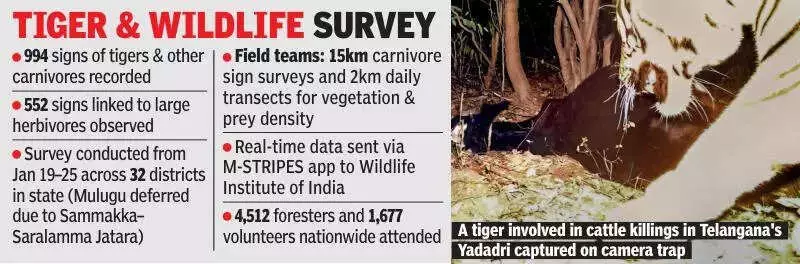
The tiger's current location is reported to be in Siddipet, an area it initially travelled from. Officials are analyzing a captured camera trap image, cross-referencing it with tiger databases from Asifabad, Mulugu, Kagaznagar, and other Telangana districts, as well as with records from neighbouring Maharashtra.
Proactive Monitoring and Multi-Agency Response Framework
The forest department initiated proactive measures immediately after the tiger entered districts including Peddapally, Karimnagar, Jagityal, Kamareddy, Siddipet, and Yadadri Bhuvanagiri. District Forest Officers (DFOs) have been tasked with continuous 24x7 monitoring, adhering strictly to the Standard Operating Procedure prescribed by the National Tiger Conservation Authority (NTCA).
DFOs are in active coordination with district collectors and superintendents of police. This collaboration is vital for crowd control at cattle kill sites and for maintaining law and order to ensure public safety in the affected villages. Furthermore, to mitigate risks, the superintending engineer of TGSPDCL has been requested to inspect agricultural fields for illegal electric lines and live wires, preventing potential electrocution hazards for the tiger, locals, and livestock.
Expert Committees and Preparedness for Contingencies
A dedicated multi-agency committee, headed by a conservator of forests, has been constituted to oversee the operation. The committee includes members from veterinary services, non-governmental organizations, wildlife experts, and the panchayat raj and forest departments. To gain specialized insights, a wildlife expert and veterinarian from Maharashtra's renowned Tadoba-Andhari Tiger Reserve has been consulted, and his recommendations are being implemented.

Preparations for all scenarios are in place. Tiger trap cages from Hyderabad's Nehru Zoological Park are on standby, ready for deployment if necessary. Veterinary teams equipped with tranquillising gear are also on alert. Additionally, a state-level technical group, featuring experts from the Wildlife Institute of India and the NTCA, is being formed. This group will provide authoritative guidance on response measures for tiger straying and related wildlife management issues.