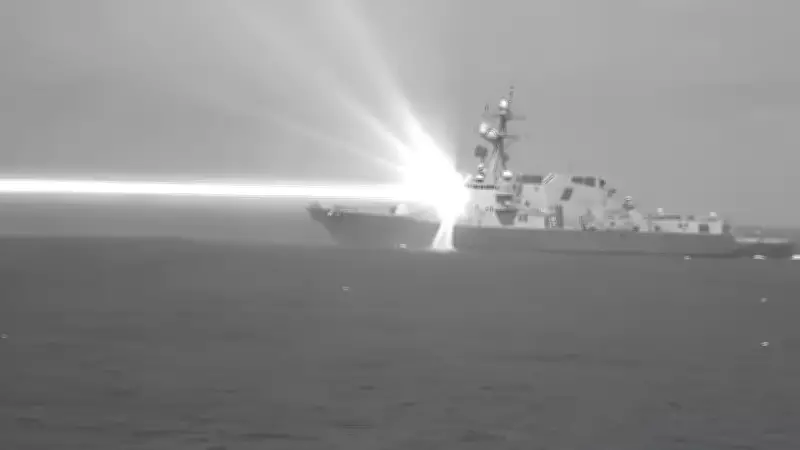
High-Energy Lasers: A Game-Changer in Defense Against Iranian Attacks
High-energy lasers are increasingly being viewed as a transformative and cost-effective solution for defending against drones and missiles, particularly those launched by Iran targeting oil refineries and US bases across the Middle East. This shift in military strategy highlights a move away from traditional, expensive missile systems toward more economical directed-energy weapons.
The Staggering Cost Difference: $3.50 vs. $3 Million
According to recent estimates, firing a laser shot costs as little as $3.50, in stark contrast to systems like the Patriot missile interceptor, which can exceed $3 million per shot to neutralize a single drone. This dramatic price disparity underscores the potential for lasers to revolutionize defense budgets and operational efficiency.
US President Donald Trump emphasized this point, telling reporters that laser technology is poised to soon undertake the roles currently filled by Patriot interceptors, but at a significantly reduced cost. "The laser technology that we have now is incredible," he stated. "It's coming out pretty soon." His comments reflect growing confidence in the rapid advancement and deployment of these systems.

Decades of Development and Global Pursuit
The concept of using lasers as weapons is not novel; US military leaders have invested decades in developing this technology, driven by the vision of a weapon that strikes at the speed of light with virtually unlimited ammunition. Other nations, including Israel and China, have also actively deployed high-powered lasers, indicating a global race toward directed-energy supremacy.
However, the US military confronts substantial hurdles in scaling up laser production and deployment. Experts caution that it may still be years before soldiers routinely utilize lasers in combat scenarios, pointing to ongoing technical and logistical challenges.
How Lasers Operate: Precision and Limitations
High-energy lasers function by concentrating beams of light on vulnerable areas of drones, effectively frying their components. David Stoudt, executive director of the Directed Energy Professional Society, likened this process to "a blowtorch at a distance." Similar to a magnifying glass focusing sunlight to ignite a fire, lasers must maintain a lock on a target for several seconds, raising concerns about their effectiveness in adverse weather or against swarms of drones.
Jared Keller, author of the Laser Wars newsletter, noted, "This isn't 'Star Trek,' where your target is disintegrated instantaneously. Lasers aren't magic. They run headlong into physics wherever they are operating." This reality highlights the practical constraints of laser technology in field conditions.
Field Limitations and Operational Challenges
While powerful under optimal conditions, high-energy lasers are not infallible. Humidity can distort light rays, fog can obstruct beams, and environmental factors like sea spray or sand can damage sensitive optical components, complicating their use and repair. In 2024, four 50-kilowatt lasers deployed to defend US bases in Iraq were reportedly found to be "cumbersome and ineffective" by soldiers, according to a Center for a New American Security report.
Scott Keeney, CEO of nLight, emphasized that while technology has advanced, it should not be oversold. "It is being used, and it will be used in more and more applications," he said. "But lasers are not the solution in every environment at all times. No one should be saying that." He added that a 100-kilowatt laser, with half the horsepower of an average car, can still damage an aircraft engine when concentrated into a narrow beam.
Civilian Risks and Global Adoption Trends
The deployment of lasers also poses risks to civilians, such as incapacitating pilots by pointing lasers at aircraft, as seen in recent incidents leading to airport closures. Nearly 11,000 laser incidents were reported to the Federal Aviation Administration last year, underscoring safety concerns.

Globally, Israel is experimenting with the Iron Beam system, Australia has supplied lasers to South Korea, Ukraine is deploying mobile systems, and China has unveiled advanced ship-mounted lasers. This widespread adoption indicates a shifting defense landscape toward directed-energy weapons.
Cost, Scale, and Production Hurdles
Although firing lasers is inexpensive, the systems themselves entail significant costs. For instance, Lockheed Martin secured a $150 million contract in 2018 to develop HELIOS, a 60-kilowatt ship-mounted system. The US Navy continues testing its durability against saltwater and humidity, while confusion persists between systems like HELIOS and ODIN, a less powerful drone-disabling variant.
Emil Michael, undersecretary of defense for research and engineering, has prioritized "scaled directed energy" as a Defense Department focus, encouraging competition among smaller companies. Under a $35 million contract, nLight delivered a 70-kilowatt laser to the Army, highlighting ongoing investments.
Scaling production remains a critical challenge, as high-energy lasers require rare-earth metals like ytterbium and gallium, predominantly sourced from China. Manufacturing components such as diffraction gratings and lenses is slow and limited, with a 2024 National Defense Industrial Association report warning that efforts to ramp up production would face issues with optical components, beam directors, and batteries.