A moderate earthquake measuring 4.6 on the Richter scale that shook Gujarat's Kutch region early on Friday has done more than just rattle windows and send residents scurrying out of their homes. It has sent a significant warning signal to the scientific community by revealing that three lesser-known fault lines in the area have now become seismically active, dramatically expanding the region's already complex and dangerous seismic map.
New Fault Lines Spring to Life
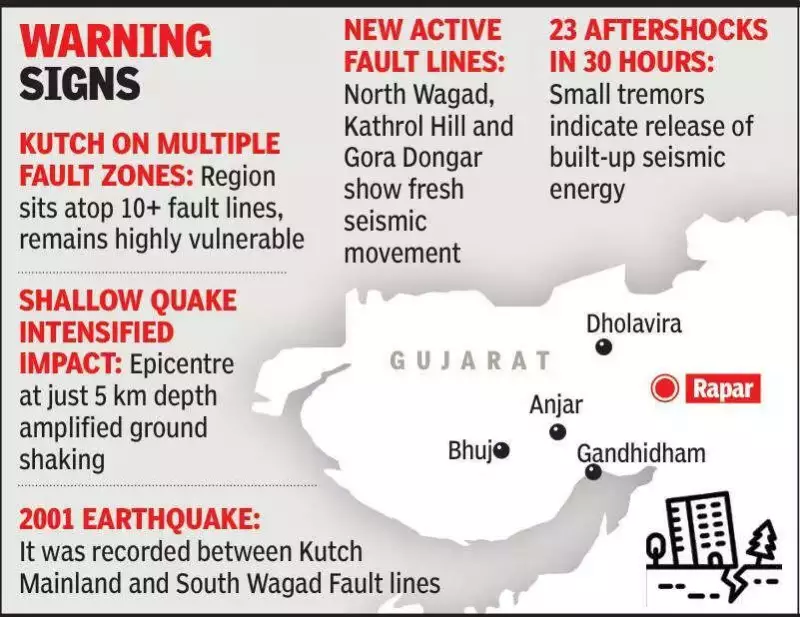
The primary tremor, which originated along the North Wagad Fault, was followed by a series of 23 aftershocks within a span of 30 hours, from 4:30 AM Friday to 9:45 AM Saturday. Until now, the North Wagad Fault was not considered among the region's most active seismic zones. More alarmingly, recent data indicates that the Kathrol Hill and Gora Dongar fault lines have also been simultaneously active since the beginning of 2025.
"Traditionally, activity was concentrated around known faults like Nagar Parkar and Allah Bund. What is worrying now is that recent tremors confirm activity along the North Wagad Fault, while quakes over the past few months along Kathrol Hill and Gora Dongar indicate all three have currently become active," explained Gaurav Chauhan, Assistant Professor in the Department of Geosciences at Kutch University in Bhuj.

Kutch's Shifting Seismic Landscape
The Kutch region already sits precariously atop more than ten known fault lines, including the notorious Kutch Mainland Fault and South Wagad Fault, which ruptured catastrophically during the devastating 2001 Bhuj earthquake that measured 7.7 in magnitude. For years, most seismic stress was released around these established zones. However, the tremors recorded in 2025 suggest a worrying shift and a spread of tectonic stress across newer fault systems.
Professor Chauhan noted that the aftershocks, ranging between magnitude 1 and 3, help release accumulated energy and can temporarily reduce the immediate risk of a major rupture. "Aftershocks are positive in terms of stress release, but the activation of multiple fault lines is also a warning. These faults are capable of generating high-intensity earthquakes, and preparedness is crucial," he cautioned.
Shallow Depth Amplified Impact, Risk Extends Beyond Kutch
Despite its moderate magnitude, Friday's quake was felt intensely across Kutch. Experts attribute the widespread strong shaking to the earthquake's shallow depth of just 5 kilometers, combined with the area's soft clay and sedimentary layers, which act to amplify ground motion.
The implications of this new seismic activity are not confined to Kutch alone. Seismologists warn that a powerful earthquake originating in this region would not remain a local event. Given the unique geology of the area, severe ground shaking could impact large parts of western India, underscoring an urgent need for heightened vigilance across a wider area.
Chauhan urged authorities to treat this development as a critical wake-up call. He called for regular earthquake mock drills, stricter enforcement of building codes designed for seismic zones, and the integration of comprehensive disaster preparedness into school curricula. "Kutch has a long history of earthquakes. These newly active fault lines remind us that the ground beneath us is still very much alive," he stated.
The activation of these three fault lines serves as a stark reminder of the dynamic and unpredictable nature of the earth beneath one of India's most quake-prone regions, making resilience and readiness more important than ever.