Kolkata's Air Quality Faces New Threat from Invisible Gases
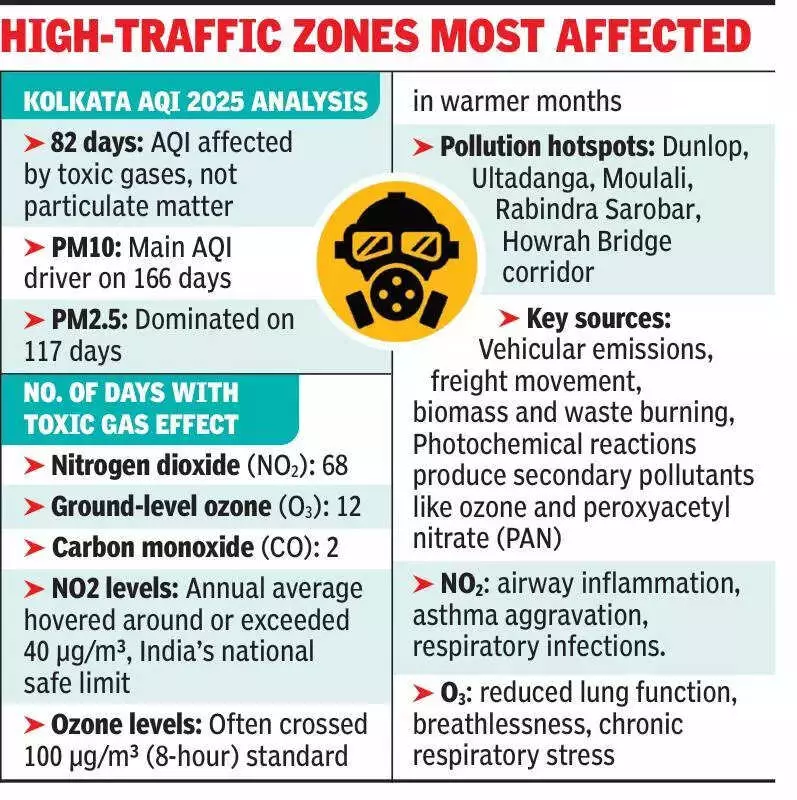
A recent study has uncovered a disturbing trend in Kolkata's air pollution. For eighty-two days last year, toxic gases like nitrogen dioxide and ground-level ozone became the main drivers of the city's Air Quality Index. This finding challenges the common perception that particulate matter alone determines air quality.
Gaseous Pollutants Take Center Stage
Climate-tech organization Respirer Living Sciences conducted this revealing analysis. Using data from their Atlas AQ platform, researchers discovered that gaseous pollutants dominated Kolkata's AQI on those eighty-two days. This occurred while particulate pollution remained a serious concern. PM10 affected air quality on one hundred sixty-six days, and PM2.5 impacted it on one hundred seventeen days.
Ronak Sutaria, founder and CEO of Respirer, explained the significance. "We often treat AQI as a proxy for particulate pollution, but the data tells a more complex story," he said. The analysis shows nitrogen dioxide was the dominant pollutant on sixty-eight of those gas-driven days. Ozone took the lead on twelve days, and carbon monoxide was primary on two days.

Dangerous Levels and Health Impacts
The study found alarming concentrations of these invisible threats. Annual average nitrogen dioxide levels in Kolkata hovered close to, and sometimes exceeded, the nationally-prescribed safe limit of forty micrograms per cubic metre. This points to sustained emissions from combustion sources.
Ozone levels frequently breached the eight-hour standard of one hundred micrograms per cubic metre, especially during warmer months. Sunlight accelerates the photochemical reactions that create this pollutant. "Ozone is particularly concerning because it's invisible and often overlooked, yet it directly affects lung function," Sutaria warned. "Even short-term exposure can aggravate asthma, trigger breathlessness, and reduce respiratory capacity."
Pollution Hotspots Identified
Spatial analysis pinpointed several areas with consistently higher pollution loads. Traffic-heavy and industrially-influenced zones emerged as major hotspots. These include Dunlop, Ultadanga, Moulali, Rabindra Sarobar, and the Howrah Bridge corridor. These locations showed particularly high levels of nitrogen dioxide and PM10.
Areas with intense vehicular congestion and freight movement experienced repeated episodes where gaseous pollutants dominated the AQI. This underscores the significant role of transport emissions alongside regional atmospheric chemistry.
Experts Explain the Chemical Reactions
Abhijit Chatterjee, a professor at the Bose Institute, provided deeper insight into the pollution sources. He noted that Kolkata emits large amounts of carbon monoxide due to widespread biomass and waste burning. "This year, because of a significant drop in temperature, people were found burning waste — including plastics and electrical items — to keep warm," Chatterjee explained. "This leads to emission of CO and carcinogenic toxic compounds like polycyclic aromatic hydrocarbons."
He further described how emissions from vehicles and other sources combine to form additional pollutants. Nitrogen oxides from vehicles and volatile organic compounds, in the presence of carbon monoxide, lead to ozone formation. "These pollutants can further react to form peroxyacetyl nitrate, which contributes to haze formation," Chatterjee added. "Such haze was observed on several winter mornings this year."
Calls for Comprehensive Action
The analysis strongly advocates for a shift in air quality management strategies. Current approaches that focus mainly on particulate matter may miss substantial health risks. Gaseous pollutants often peak at different times of day, even when PM readings appear acceptable.
"If cities continue to treat air pollution purely as a particulate problem, they risk missing a substantial part of the health burden," Sutaria emphasized. "AQI is designed to be multi-pollutant, and our responses must reflect that."
Respirer's report calls for several key measures:

- Stronger controls on gaseous emissions from all sources
- Better public communication about multi-pollutant risks
- Time-specific health advisories based on pollutant patterns
- Comprehensive monitoring that tracks all major pollutants
This research highlights that Kolkata's air toxicity is increasingly multi-pollutant in nature. Addressing this complex challenge requires recognizing that dangerous air comes in more forms than just visible dust and particles.