Three full days after the New Year's Eve celebrations, the air in Kolkata is still struggling to recover from the impact of widespread fireworks. Monitoring data shows that pollution levels are dropping at a slow and uneven pace, with most parts of the city still breathing 'poor' to 'very poor' quality air.
Stations Report Persistent Poor Air
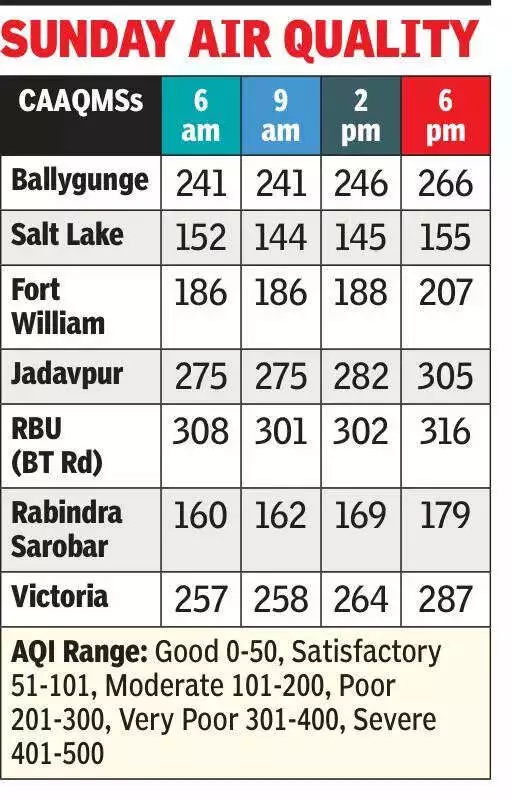
Readings from the city's Continuous Ambient Air Quality Monitoring Systems (CAAQMS) painted a grim picture on Sunday. Out of seven stations, only two managed to record 'moderate' air quality by the evening. The rest continued to languish in the 'poor' or 'very poor' categories, indicating that pollutants from firecrackers are lingering.
Experts point to meteorological conditions as the main culprit. Low wind speeds combined with a temperature inversion are trapping harmful particles close to the ground, preventing their dispersal.

Worst-Affected Areas and Readings
The situation was particularly severe in several neighbourhoods. At Ballygunge, the Air Quality Index (AQI) stayed in the 'poor' band all day, climbing from 241 at 6 am to 266 by 6 pm.
Jadavpur saw a sharper decline, with its AQI worsening from 275 in the morning to 305 in the evening, pushing it into the 'very poor' zone. The Rabindra Bharati University station on BT Road recorded some of the day's highest pollution, with AQI consistently above 300 and peaking at 316.
Two stations flanking the Maidan, Victoria and Fort William, also reported high pollution. Victoria's AQI rose from 257 to 287, while Fort William's increased from 186 to 207, moving it from 'moderate' to 'poor'. Apart from ongoing metro construction, experts noted that polluted wind from northern bus depots and dense traffic contributed to the problem.
Health Warnings and a Slow Path to Recovery
Doctors and environmental experts have issued health advisories, stating that the current AQI levels pose significant risks. Children, the elderly, and individuals with pre-existing respiratory or heart conditions are especially vulnerable. Prolonged exposure can cause eye and throat irritation, breathing difficulties, and can aggravate asthma and other lung diseases.
Authorities are advising residents to limit time outdoors, avoid heavy exercise during peak pollution hours, and use protective masks when necessary. With no strong winds or rain predicted in the immediate forecast, officials expect air quality to improve only gradually in the coming days.
This episode serves as a stark reminder of the lasting environmental damage caused by festive fireworks. It highlights the urgent need for stronger enforcement of regulations and greater public awareness to prevent such severe pollution spikes after celebrations.