

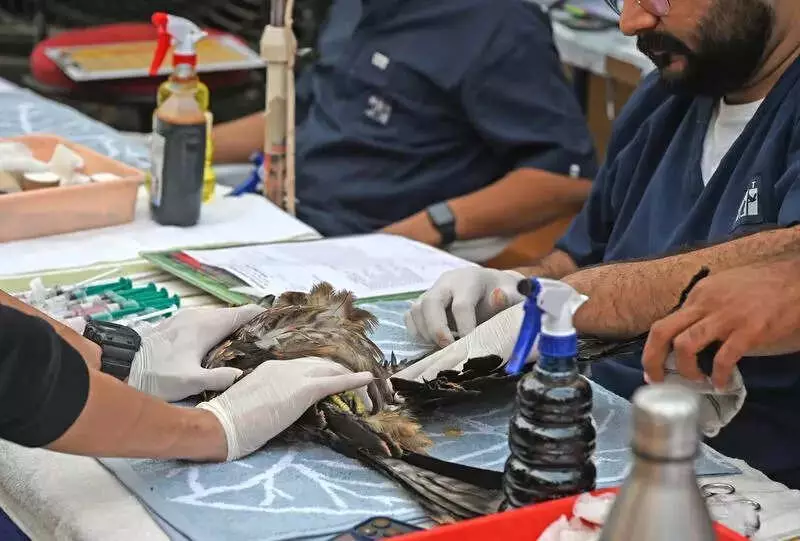
Hundreds of birds have fallen victim to kite-string injuries in Ahmedabad as the city prepares for the Uttarayan festival. Rescue numbers are climbing sharply compared to last year, raising serious concerns among wildlife experts.
Rescue Numbers Show Alarming Increase
The Jivdaya Charitable Trust recorded 736 injured birds between January 1 and 9 this year. They also treated 72 chicks and 15 animals, bringing the total to 823 cases. Most of these injuries come from kite-string wounds.
During the same period last year, JCT treated 582 injured birds. That averaged 84 cases daily. This year's count of 736 birds over nine days represents 92 injuries per day. This notable increase comes even before the festival's peak week.

Common Victims and Migratory Concerns
Pigeons and kites comprise the majority of casualties. The trust's register shows pigeons alone account for 178 cases. Black kites were the second worst hit with 39 injuries. Rose-ringed parakeets and crows accounted for 10 cases each.
What worries rescuers most is the diversity of species affected. The list of injured birds this year includes painted storks, a pelican, a lapwing, green pigeons, black ibises, kingfishers, barn owls and a greater spotted eagle. Many of these birds migrate through Gujarat or depend on wetlands and open landscapes.
"This is the peak migratory season," said Gira Shah, trustee at JCT. "Many birds are either arriving or nesting now. When kite flying starts in late December or early January, it overlaps with this ecological window. The manjha becomes an invisible trap in the air, especially for large birds like storks, kites and eagles."
Extended Risk Period and Hidden Dangers
Alongside birds, JCT treated 15 squirrels, bats and other small wildlife. These animals got entangled in loose kite strings hanging from trees, balconies and electric lines.
Rescuers point out that what changed is not just the volume of kite flying, but its timing. People now start flying kites from late December. The risk period has stretched from a few days to nearly a month. In fact, this year, the first case encountered by JCT was on November 15.
"Loose manjha left on rooftops and wires keeps injuring birds even when no one is flying kites," Shah explained. "Many birds are brought in with deep wing cuts, neck lacerations or fractured bones."
In December 2025 alone, the trust handled 2,373 cases. This included 1,917 birds, showing how the danger begins weeks before Uttarayan.
Government Response and Rescue Efforts
To address the increase in bird and animal injuries during Uttarayan, the Gujarat government has launched its annual Karuna Abhiyan. The campaign runs from January 10 to 20. Forest and environment minister Arjun Modhwadia said the campaign, running since 2015, enabled the rescue of over 1.12 lakh animals and birds across the state.
This year, 450 collection centers, 85 control rooms and 480 treatment centers will operate. They will have support from 740 vets and 8,500 staff and volunteers. Citizens can seek help by calling 1962 or the wildlife helpline 83200 02000.

What to Do If You Find an Injured Bird
- Gently cover it with a cloth or towel
- Place it in a ventilated box
- Do not give food or water
- Do not try to pull out the kite string
- Call a trained rescuer, the JCT helpline, or the Karuna Helpline immediately
Safe Kite Flying Practices
- Avoid flying kites from 8am-10am and 4pm-6pm
- Do not use Chinese manjha or plastic thread
- Collect and dispose of loose strings after flying
- Avoid flying at night





