Supreme Leader's Death in Coordinated Strike Sparks Regional Chaos
In a dramatic escalation of Middle East tensions, Iranian state television confirmed early Sunday that Supreme Leader Ayatollah Ali Khamenei was killed in what appears to be a coordinated US-Israeli military operation. The 84-year-old cleric, who had ruled Iran since 1989, died during the opening wave of strikes that immediately triggered retaliatory Iranian missile launches across the region.
Immediate Fallout and Conflicting Reactions
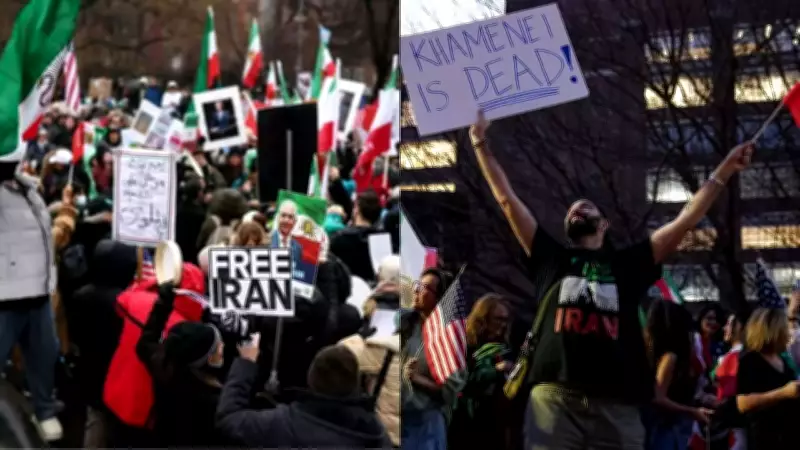
The confirmation of Khamenei's death came after hours of fragmentary reports circulating through Saturday night, setting off dramatically different scenes across Iran. While some neighborhoods erupted in spontaneous celebration, with residents honking car horns and dancing in streets, other areas saw mass mourning rallies organized by regime loyalists.
President Donald Trump framed the development as a historic opportunity, declaring: "This is the single greatest chance for the Iranian people to take back their Country." Israeli Prime Minister Benjamin Netanyahu echoed this sentiment, urging Iranians to "join forces, to overthrow the regime and to secure your future."

Meanwhile, in Tehran's Enghlab Square, thousands of mourners gathered chanting "death to America" even as other parts of the capital witnessed celebrations. The New York Times reported "large crowds" celebrating in multiple cities, with chants of "freedom, freedom" and rooftop shouts declaring "Khamenei went to hell."
Military Escalation and Security Apparatus Response
Iran's military leadership responded with immediate escalation rather than surrender. The Islamic Revolutionary Guard Corps vowed the "most ferocious" operation in history against Israel and US bases, according to AFP reports. Explosions and sirens were reported from Gulf capitals including Dubai, Doha, and Manama as Iranian retaliatory strikes targeted regional assets.
The attack appears to have decapitated significant portions of Iran's security elite. Iran's judiciary confirmed that Ali Shamkhani, a top national security adviser, and General Mohammad Pakpour, head of the Revolutionary Guards, were also killed in the strike. Reuters reported the operation was timed using real-time intelligence about a meeting involving Khamenei and senior aides.
Constitutional Mechanisms and Power Transition
Under Iran's constitutional procedures, an interim Leadership Council has formed quickly to carry out the supreme leader's duties until the Assembly of Experts selects a permanent successor. ISNA news agency reported that cleric Alireza Arafi has been named as the jurist representative on this three-member panel, joining President Masoud Pezeshkian and Chief Justice Gholamhossein Mohseni Ejei.
This transition occurs amid what analysts describe as the biggest shock to Iran's power structure since the 1979 Islamic Revolution. The critical question now facing regional observers is whether popular anger can translate into meaningful political change faster than the security apparatus can reassert control.
Street Dynamics and Security Challenges
Initial reports from Tehran paint a complex picture of public sentiment. One resident identified only as Sara described to The New York Times how private celebrations quickly turned public: "Then we bolted outside and shouted from the top of our lungs and laughed and danced with our neighbors."
However, these celebrations occurred under significant constraints, with landline and cellular services reportedly disrupted. The regime demonstrated it could still mobilize loyalist crowds, as evidenced by the thousands of mourners in black gathering at Enghlab Square.
The Revolutionary Guards and their Basij militia represent the regime's coercive backbone, having expanded their influence through political and economic networks over decades. Their response to this crisis will be crucial in determining whether the system maintains control or fractures under pressure.
Strategic Implications and Future Scenarios
Academic analysis from The Conversation suggests skepticism about a successful popular uprising under current conditions. Donald Heflin, a veteran diplomat, argued: "I would be surprised if we saw a popular uprising in Iran that really had a chance of bringing the regime down."

Several critical factors will determine the coming days and weeks:
- Protest sustainability: Whether celebrations evolve into sustained occupation of public squares or dissipate under security pressure
- Military cohesion: Whether external threats create "rally-round-the-flag" unity or expose fractures within security forces
- Conflict escalation: Whether missile exchanges intensify, potentially shifting domestic priorities from regime change to survival
- Elite dynamics: Whether the Revolutionary Guards emerge as kingmakers or the system hardens under security hardliners
The symbolism of Khamenei's death represents an enormous psychological blow to the Islamic Republic's legitimacy. However, transforming street courage into meaningful political change requires more than symbolic victories—it demands either the splintering of the regime's coercive apparatus or its neutralization before it can reorganize under wartime conditions.
As regional tensions escalate with new missile salvos reported across the Gulf and Israel, the immediate future appears dominated by military confrontation rather than political transition. The coming days will reveal whether Iran's power structure can withstand this unprecedented challenge or whether Khamenei's death marks the beginning of the Islamic Republic's unraveling.