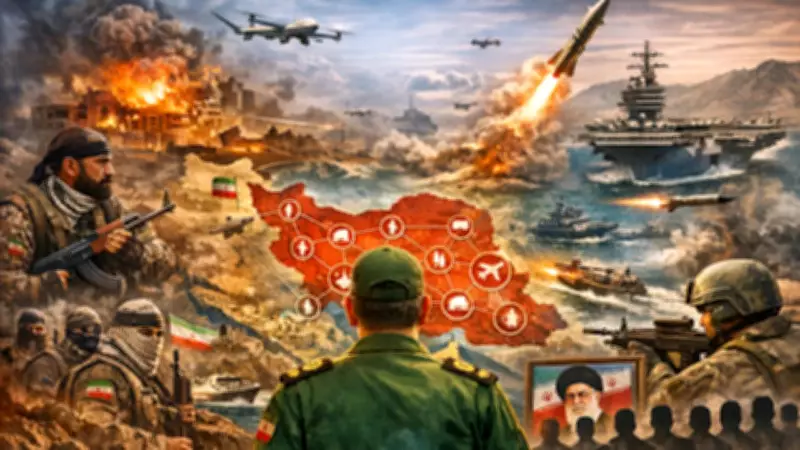
Inside Iran's Mosaic Defense Strategy: Why Eliminating Top Commanders May Not End the Conflict
What occurs when a nation anticipates the assassination of its generals, the bombing of its command centers, and the disruption of its communications—yet still plans to continue fighting? This critical question lies at the core of Iran's so-called "mosaic defense" strategy, a decentralized war doctrine engineered to ensure the state can withstand catastrophic early attacks and maintain operational capabilities.
The Essence of Mosaic Defense
As regional tensions escalate, this concept has garnered renewed attention after Iranian Foreign Minister Abbas Araghchi publicly cited it as evidence that Tehran's military framework is designed to endure even under extreme duress. In straightforward terms, mosaic defense is a decentralized model aimed at preventing a single devastating strike from paralyzing Iran's war machine.
The doctrine operates on the assumption that in any major conflict with the United States or Israel, Iran might lose senior commanders, critical infrastructure, and centralized control, but must avoid systemic collapse. At its heart, mosaic defense revolves around dispersion, redundancy, and layered command structures. Rather than depending on a single central military "brain," authority is distributed across multiple geographic and organizational nodes. If one node is destroyed, others are expected to continue functioning autonomously.

Historical Roots and Development
Iran's adoption of this decentralized defense model was heavily influenced by lessons from regional conflicts. The rapid downfall of Saddam Hussein's regime in Iraq in 2003 left a profound impact on Iranian strategic thought. Tehran observed how a highly centralized state could quickly disintegrate once its command structure was shattered by overwhelming U.S. military power.
Iranian strategists derived clear insights from U.S. campaigns in Afghanistan and Iraq, concluding that survivability in modern warfare would hinge less on defending a central core and more on dispersing power across numerous operational nodes. The origins trace back even further to the Iran-Iraq War of 1980-1988, which fundamentally shaped Tehran's military mindset by demonstrating that survival depended more on endurance, dispersion, and the capacity to absorb prolonged punishment than on decisive battlefield victories.
Operational Mechanisms and Structure
In practice, mosaic defense is not merely a theoretical concept but an institutional design. The Islamic Revolutionary Guard Corps (IRGC) is structured into 31 command centers—one for Tehran and one for each of Iran's 30 provinces—each empowered to assume authority if top leadership is eliminated. This provincial distribution is crucial for the system's functionality during wartime.
According to reports, the Revolutionary Guards have delegated authority extensively down the ranks and established "successor ladders" so units can continue operating if commanders are killed. Iranian Deputy Defense Minister Reza Talaeinik stated in a televised interview that each figure in the command structure has designated successors "stretching three ranks down" ready to assume their roles.
After 2007, Basij paramilitary units were integrated into a provincial command system spanning Iran's 31 provinces, granting local commanders greater autonomy to act based on terrain and battlefield conditions. This local freedom is vital: if higher leadership is disrupted, warfare can persist from grassroots levels.
Roles of Key Military Institutions
Iran's mosaic defense is layered, with different institutions fulfilling distinct wartime roles. The regular army, or Artesh, is expected to absorb the initial assault, with its mechanized, armored, and infantry formations forming the first defensive line to slow enemy advances and stabilize fronts.

The IRGC and Basij become increasingly central as the conflict intensifies. Their role is to transition the fight into decentralized attrition through ambushes, local resistance, disruption of supply lines, guerrilla-style operations, and flexible actions across urban, mountainous, and remote areas. The Basij, a volunteer paramilitary group with hundreds of thousands of members embedded deeply into Iranian society, is particularly significant for preventing internal unrest during wartime, thereby ensuring regime survival alongside battlefield endurance.
Geographic and Economic Dimensions
Iran's terrain plays a pivotal role in the doctrine. Population centers and key communication lines are situated deep within the country, behind rugged mountain ranges that render enemy supply lines vulnerable. The Persian Gulf, with its narrow widths limiting large vessel maneuverability, favors Iran's asymmetric naval tactics, including fast attack craft, sea mines, and anti-ship missiles.
A key aspect of mosaic defense is economic attrition. Iran's strategy leverages relatively inexpensive weapons, such as Shahed drones costing around $35,000 to produce, to force adversaries into costly defensive responses. This cost-imposition game aims to make prolonged defense financially and politically unsustainable for opponents, turning time into a strategic weapon.
Regional and Strategic Implications
Mosaic defense extends beyond Iran's borders through "forward defense," where national security is protected by pushing confrontations outward. By targeting Gulf Arab states and global economic arteries, Iran seeks to widen conflicts and increase the cost for adversaries like the U.S., leveraging the interconnectedness of the Middle East's military bases, energy corridors, and maritime chokepoints.
This marks a shift from Tehran's earlier restrained responses, reflecting a more deliberate embrace of escalation as deterrence. The doctrine emphasizes continuity under fire, with Supreme Leader Ali Khamenei reportedly instructing senior officials to ensure multiple predesignated successors for key posts, sometimes up to four replacements per role, to prevent paralysis from leadership losses.
Risks and Global Attention
While mosaic defense offers resilience, it also introduces dangers. Delegation increases unpredictability, raising risks of miscalculation or uncontrolled escalation as mid-ranking officers gain operational autonomy. This could trigger wider conflicts even if central leadership does not intend it.
For Western militaries, this doctrine challenges the assumption that precision strikes on leadership and command nodes can rapidly cripple an adversary. Instead, decapitation may lead to diffusion, spreading conflicts across more theaters and requiring opponents to target broader networks like logistics, communications, and proxy linkages.
Conclusion
Iran's mosaic defense strategy is built on a powerful premise: if the center is destroyed, the system must still function. It combines decentralized command, deep succession planning, provincial autonomy, irregular warfare, social mobilization, missile and drone attrition, difficult terrain, and regional escalation into a cohesive framework designed to survive shock and deny quick victories.
In essence, it is Iran's response to doctrines of rapid dominance and precision decapitation. As current conflicts demonstrate, its primary purpose is not necessarily to win swiftly but to ensure Iran does not lose quickly, making any future war longer, broader, and more economically disruptive than conventional campaigns might suggest.