

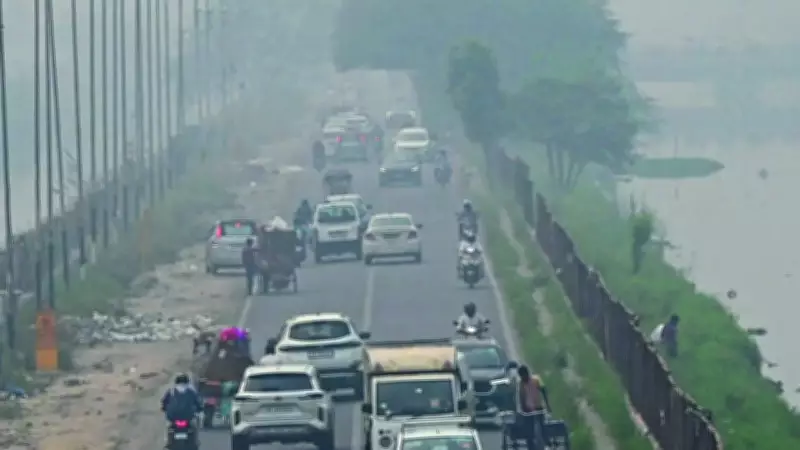
Unseasonal Haze in North India Unlikely Caused by Iran Fires, Experts Say
Unseasonal fog and haze that blanketed parts of north India, including Delhi-NCR, on Tuesday morning are improbable to have originated from smoke and soot rising from oil depots and facilities in war-hit Iran, which have been ablaze for three days, according to air pollution experts. The phenomenon, observed from Haryana to Bengal and beyond, saw visibility drop to as low as 600 meters at Hindon Airport in the National Capital Region during the early hours.
Wind Patterns and Satellite Data Rule Out Direct Impact
Gufran Beig, an air pollution expert from the National Institute of Advanced Studies in Bengaluru, explained that upper atmospheric winds from Iran are currently moving westward, preventing the plume from the fires from traveling the extensive distance to India. "Satellite images indicate the plume has covered approximately 500 kilometers, only about a quarter of the journey to India," Beig stated. "It is unlikely to persist long enough to affect air quality here unless the fires continue with high intensity and combine with dust storms."
Reports from Iran describe massive fires at oil infrastructure following bombings, leading to black rain in Tehran and obscured sunlight, sparking speculation about toxic smoke spreading regionally, potentially reaching India. However, Mrutyunjay Mohapatra, chief of the India Meteorological Department (IMD), noted that while wind direction might favor transport of soot from Iran towards India, multiple factors influence such movement. "Whether it will actually travel that far depends on variables like the type of smoke, its atmospheric depth, and persistence, which fall outside IMD's purview," Mohapatra said.

Local Factors Behind the Haze Formation
Meteorological officials attributed the haze in north India to moisture-laden easterly winds interacting with calm conditions at lower atmospheric levels. R K Jenamani, a senior scientist at IMD, highlighted that while haze or fog in warm March conditions is rare, it is not unprecedented. "Historical data shows dense fog occurred in early March, such as on March 6-8, 2008, when it caused power transmission failures across north India," Jenamani recalled.
Mahesh Palawat from Skymet Weather suggested the haze resulted from a combination of dust and moisture influenced by an ongoing western disturbance. "This is haze, caused by dust carried from Balochistan and the Thar Desert of Rajasthan," Palawat explained. He added that another western disturbance is expected to impact the region from March 14 onwards, slightly lowering daytime temperatures and bringing chances of rain on March 15.
Temperature and Air Quality Trends in Delhi
Meanwhile, Delhi experienced its fourth consecutive day with maximum temperatures exceeding 35 degrees Celsius on Tuesday. The maximum temperature reached 35.5 degrees Celsius, seven notches above normal, compared to 35.3 degrees Celsius the previous day. The minimum temperature was recorded at 18.8 degrees Celsius, five notches above normal, down from 19 degrees Celsius a day earlier. IMD forecasts maximum and minimum temperatures to hover around 35-37 degrees Celsius and 17-19 degrees Celsius on Wednesday, with a gradual reduction expected by March 15.
Air quality in Delhi worsened, with the Air Quality Index (AQI) rising to 265, classified as poor, from 209 the previous day. A statement from the Centre's early warning system predicted air quality to remain in the poor category from March 10 to 11, improving to moderate levels on March 12 and 13.
In summary, while concerns about transboundary pollution from Iran's fires persist, current evidence points to local meteorological conditions as the primary driver of the unseasonal haze in north India, with experts emphasizing the role of dust, moisture, and wind patterns in shaping air quality and visibility.






