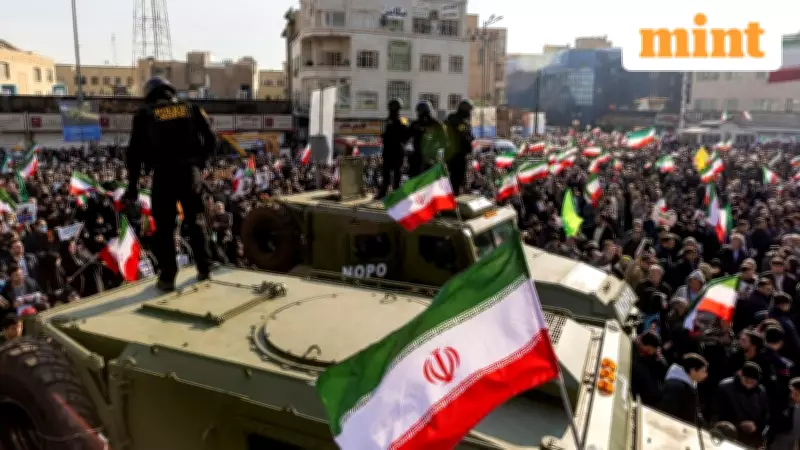
Iran Confronts Critical Crossroads as Trump Delivers Stark Nuclear Ultimatum
President Donald Trump's forceful ultimatum to Iran demanding negotiations to dismantle its nuclear program or face potential military action has placed Tehran's leadership in an exceptionally difficult position. The regime now confronts two equally challenging paths, both threatening to further destabilize an already weakened government facing its most severe external threats in decades.
The Stark Choice: Humiliation or Vulnerability
Trump's social media message on Wednesday delivered a clear warning: "Hopefully Iran will quickly 'Come to the Table' and negotiate a fair and equitable deal—NO NUCLEAR WEAPONS—one that is good for all parties. Time is running out. The next attack will be far worse!" This statement underscores the administration's escalating pressure campaign against the Islamic Republic.
For Supreme Leader Ali Khamenei, accepting the key U.S. demand to halt uranium enrichment would represent a humiliating public retreat on what has become a core national priority. Conversely, rejecting this demand significantly increases the likelihood of Trump ordering military strikes, which would further expose the government's vulnerabilities at a time when it is already grappling with fierce protests over deep economic problems.

Strategic Calculations in a Weakened Position
Analysts note that Iran finds itself in a substantially weaker position compared to just one year ago. The regime has been battered by the 12-day June war and tightened sanctions on its crucial oil exports last fall. Meanwhile, U.S. demands for a negotiated solution have become more comprehensive and stringent.
"Their strategy right now is just buying time," observed Alan Eyre, a former senior U.S. diplomat specializing in Iran who now works at the Middle East Institute in Washington. "Their whole strategic outlook is when you're in a weak position you don't compromise, because that invites further aggression."
Expanding Demands and Limited Room for Compromise
Beyond insisting that Iran halt domestic enrichment of nuclear fuel and surrender its uranium stockpile, Trump's special envoy Steve Witkoff has indicated Tehran must accept limits on its ballistic-missile arsenal and abandon support for regional militias. These expanded requirements present significant obstacles to any potential agreement.
Iranian officials have already rejected several of Washington's terms. A senior Iranian official emphasized that Tehran would not compromise on its right to continue enrichment for civilian purposes or maintain its missile arsenal, which it considers essential for national defense. Even a U.S. offer to ease sanctions that have devastated Iran's economy in exchange for nuclear limitations would be difficult for the regime to accept, given how Khamenei has elevated the nuclear program into a symbol of Iran's defiance against Western powers.
"The supreme leader is able to do compromises, but those compromises cannot touch the basic pillars of the regime," explained Danny Citrinowicz, a former Israeli intelligence officer and senior researcher at the Tel Aviv-based Institute for National Security Studies. "Meaning he won't forgo a missile buildup, he won't forgo helping proxies and he won't forgo enrichment."
Retaliation Threats and Escalation Risks
In an attempt to deter potential U.S. attacks, Iranian officials are threatening massive retaliation against American bases, warships, and regional allies including Israel. However, executing such threats represents a risky strategy that would require revealing the full extent of Iran's missile and drone capabilities while potentially inviting further escalation from the Trump administration.
The senior Iranian official stated that the country would have no option but to consider any U.S. attack, whether limited or extensive, as an existential threat requiring the most forceful possible response. Iran's mission to the United Nations reinforced this position in response to Trump's warnings, arguing that the U.S. was embarking on another risky conflict while mimicking the president's all-caps communication style.

Economic Pressure as Alternative Strategy
Beyond military options, Trump could pursue a strategy of intensifying economic pressure on Iran's already struggling economy. This approach might include attempts to choke off Tehran's oil exports by intercepting so-called ghost-fleet tankers—a tactic similar to what was employed against Venezuelan President Nicolás Maduro earlier this month.
Karim Sadjadpour, a senior fellow at the Carnegie Endowment for International Peace in Washington, suggested this Venezuela playbook would envision using "economic strangulation as a precursor to political, and possibly military, decapitation, aimed ultimately at Ayatollah Khamenei."
Regime Cohesion Despite Multiple Setbacks
Despite the numerous setbacks the Iranian regime has endured, there are few indications of imminent collapse. The leadership maintains cohesion, with no significant splits or defections at the top levels of the Islamic Revolutionary Guard Corps, the paramilitary organization closely aligned with Khamenei.
"They still have cohesion. The regime is still functioning," Citrinowicz noted. "If they feel this war is aimed at toppling this regime, it won't topple this regime, because to do it will take time, and Trump has no intention to invest that time."
Military Buildup and Operational Considerations
The Pentagon has significantly increased its military presence in the region, deploying an aircraft carrier with three guided missile destroyers, warplanes, and missile defense systems. Trump described this "massive Armada" as "moving quickly, with great power, enthusiasm, and purpose," adding that it was "ready, willing, and able to rapidly fulfill its mission, with speed and violence, if necessary."
This enhanced military capability provides Trump with greater options for both offensive operations and defensive measures. The White House and Pentagon continue to refine potential courses of action, though the president has not yet made a definitive decision about whether to authorize strikes, according to U.S. officials.
The Limits of External Intervention
Ultimately, the United States faces its own limitations in determining Iran's political future through external military force. Analysts suggest that without deploying ground troops to influence events inside the country, there is little that can be accomplished from outside to fundamentally alter the regime's trajectory.
"You could do airstrikes that significantly restrict this regime's ability to control its population and to project power abroad," Eyre acknowledged. "But to get from there to a better form of government in Iran? You can't get there from here."
The situation remains exceptionally volatile, with both sides preparing for potential confrontation while maintaining rhetorical positions that leave little room for diplomatic maneuvering. As tensions continue to escalate, the international community watches anxiously, aware that any miscalculation could trigger a broader regional conflict with unpredictable consequences.