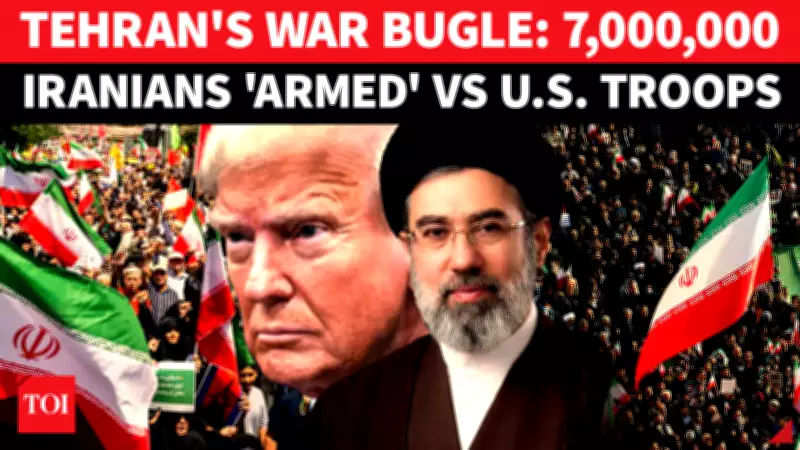
Iran Announces Massive Civilian Mobilization Amid Rising US Tensions
As diplomatic strains between Iran and the United States intensify, Tehran is amplifying both its military readiness and public rhetoric regarding a possible confrontation. In a significant development, Iran's parliament speaker, Mohammad Bagher Ghalibaf, has asserted that approximately 7 million Iranians are prepared to take up arms if the United States launches a ground invasion. This declaration, if verified, represents an unprecedented scale of civilian mobilization in the region.
Official Claims of Widespread National Resolve
Ghalibaf detailed this mobilization effort in a social media post, describing it as a "powerful national campaign" that has reportedly attracted millions of volunteers across Iran within a matter of days. According to his statement, citizens from various backgrounds have proactively expressed their willingness to defend the nation, which Iranian officials are portraying as evidence of deep-seated patriotic commitment.
This announcement comes against a backdrop of heightened threats and posturing from both sides, with former US President Donald Trump having previously hinted at military action against Iran. The Iranian leadership appears to be leveraging this volunteer drive not only as a defensive measure but also as a psychological deterrent, aiming to showcase the country's capacity for a protracted, large-scale resistance.

Context of Escalating Geopolitical Friction
The claim of 7 million volunteers emerges amidst a series of regional flashpoints and proxy conflicts involving Iranian allies, such as the Houthis in Yemen and Hezbollah in Lebanon. These groups have recently engaged in actions that further complicate the security landscape, including strikes in the Red Sea and tensions along the Israeli-Lebanese border.
Analysts suggest that Iran's mobilization rhetoric serves multiple strategic purposes:
- Demonstrating domestic unity and resilience to external adversaries.
- Potentially dissuading US military planners by highlighting the logistical and human costs of an invasion.
- Reinforcing Iran's narrative of being a nation under siege, thereby galvanizing internal support.
While the exact veracity of the 7-million figure remains unconfirmed by independent sources, the statement itself marks a notable escalation in Iran's public messaging. It underscores the regime's intent to frame any potential conflict as a national struggle, rather than merely a conventional military engagement.
Broader Implications for Regional Stability
This development adds another layer of complexity to an already volatile Middle East, where incidents like the alleged destruction of US surveillance aircraft and naval confrontations in the Strait of Hormuz have periodically flared. The involvement of global powers, including Russia and France, in related diplomatic spats further illustrates the international ramifications of the Iran-US standoff.
As both nations continue to exchange warnings and demonstrations of force, the prospect of miscalculation or unintended escalation looms large. The Iranian claim of mass civilian readiness, whether fully accurate or partly symbolic, reflects a calculated move to shape perceptions and prepare the populace for a scenario that Tehran insists it did not seek but is prepared to confront.