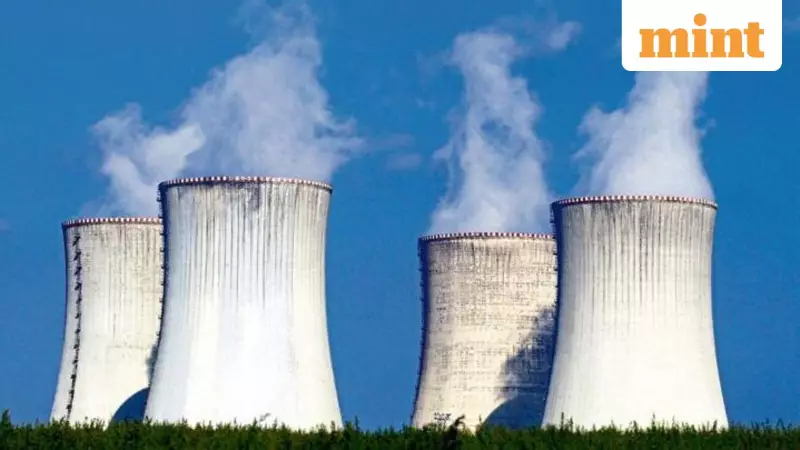
India has set an ambitious target to significantly expand its nuclear power capacity to 100 gigawatts (GW) by the year 2047, a move central to its strategy for reducing carbon emissions from electricity generation. This goal, which would see nuclear's share in the grid rise from a mere 2% today to about 5%, follows the recent passage of a pivotal law that actively encourages private sector participation in the country's nuclear industry.
The Promise and Peril of Nuclear Expansion
The global interest in nuclear energy has revived, primarily for its potential role in climate action. Unlike solar and wind power, which depend on weather conditions, nuclear plants can generate steady, carbon-free electricity around the clock. This reliability is a key asset for a nation whose per capita electricity consumption is currently half the world average and which aspires to become a developed economy by 2047.
However, the path is fraught with challenges. Nuclear projects are notorious for their long gestation periods and high fixed costs. Public safety concerns, fueled by memories of accidents like Chernobyl and Fukushima, often lead to resistance. Furthermore, India's indigenous three-stage nuclear programme has seen slow progress, with the second stage yet to fully fructify before a potential transition to thorium-based fuel, which is more abundant domestically than suitable uranium.

The Cost Calculus and Technological Shifts
Achieving the larger national goal demands that electricity tariffs remain low enough for Indian industry to stay globally competitive. This makes getting the power sector's cost calculus critical. While nuclear offers large volumes of reliable green power, the rapidly falling costs of battery storage could make solar and wind projects backed by batteries more cost-competitive in the future.
Technological innovation is also reshaping the landscape. The power-intensive demands of Artificial Intelligence (AI), coupled with investments from Big Tech firms seeking to meet climate goals, have spurred a rethink in reactor design. This has led to the development of Small Modular Reactors (SMRs), which promise to overcome traditional drawbacks like size and cost. While over 80 SMR designs exist globally, only about four plants have been established so far, indicating the technology is still in early stages.
Navigating Trade-offs for an Optimal Energy Mix
The government's policy framework must account for complex trade-offs. Fiscal incentives could enhance nuclear power's competitiveness, but this must be paired with developing project execution expertise to compress construction timelines and costs. Other factors include the variable cost of nuclear fuel, the significantly smaller land footprint of reactors compared to vast solar or wind farms, and the long-term costs associated with the safe storage of spent fuel.
Broadly, India needs comprehensive resource-adequacy mapping across sectors to deploy an optimal energy policy. Green ambitions must not come at the expense of economic growth, requiring a reliance on efficiency gains, carbon markets, and international climate finance. The Centre must also build the institutional capacity necessary to oversee and manage the anticipated growth in nuclear energy, ensuring that safety standards are never compromised.
In conclusion, while the conditions for a nuclear ramp-up have been created, a cautious, cost-aware approach is essential. India cannot afford to go into nuclear overdrive but must strategically integrate it into a diverse energy portfolio that includes fast-improving renewables to secure a clean and affordable power future.