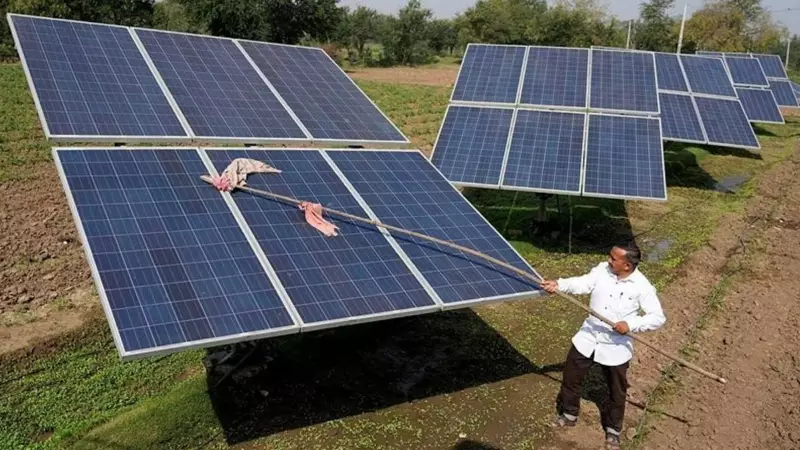
India's ambitious clean energy transition is gaining remarkable momentum, yet it faces critical bottlenecks that could hinder its quest for true energy independence. For years, the nation's solar sector was heavily reliant on imports from China. That dynamic is now shifting dramatically, driven by strong policy support and significant domestic investment. However, experts warn that without addressing upstream manufacturing gaps and financial ecosystem stresses, the country risks merely shifting its dependence rather than eliminating it.
Manufacturing Boom and the Integration Challenge
The year 2024 marked a watershed moment for India's solar manufacturing landscape. Domestic companies added a staggering 25.3 gigawatts (GW) of new module capacity, nearly doubling the national manufacturing strength. This explosive growth has been catalysed by the Production Linked Incentive (PLI) scheme, which has successfully attracted investment and signalled India's intent to become a global technology producer, not just a consumer.
Technological advancement is also evident, with the industry's adoption of high-efficiency TOPCon cells indicating a move towards higher-value innovation. Despite this progress, a significant contradiction remains. In the same year, India imported nearly 66 GW of solar modules and cells, while its exports saw a slight decline. The core issue lies in limited upstream integration. While module production has soared, the commissioning of wafer capacity stands at a mere 2 GW, a tiny fraction compared to downstream output. Without developing robust polysilicon and wafer production bases, the solar value chain remains vulnerable.

Financial Flux and Grid Constraints
The clean energy sector continues to attract substantial capital, drawing $3.4 billion in foreign investment in the first nine months of FY2025, accounting for over 80% of all power sector inflows. Competitive auctions have driven tariffs to record lows, making renewables one of India's cheapest electricity sources. However, the financial ecosystem shows signs of strain.
Distribution companies (DISCOMs) are burdened with unpaid dues, and instances of states attempting to renegotiate contracts post-auction have raised red flags about contractual sanctity. Such uncertainty directly undermines investor confidence. Furthermore, around 60 GW of renewable projects are constrained by inadequate transmission infrastructure. Without parallel grid expansion, clean power cannot reach demand centres.
The problem of curtailment—where grid operators reduce renewable output due to stability or transmission issues—adds another layer of financial risk. Developers often receive no compensation for this curtailed power, complicating financial models and raising the overall cost of capital. Consequently, India's renewable financing costs remain nearly 80% higher than in advanced economies.
The Green Hydrogen Gambit
Looking beyond solar, India has placed a major bet on green hydrogen with its National Green Hydrogen Mission. The target is to produce 5 million metric tonnes annually by 2030, with pilot projects already launched in hard-to-abate sectors like steel, refining, and transportation. The strategic logic is sound, aiming to replace the approximately 5 million tonnes of grey hydrogen currently derived from fossil fuels.
Nevertheless, the economics are currently challenging. Production costs range between $4.1 and $5.0 per kilogram, several times higher than conventional hydrogen. Even with projected cost reductions to around $2.4 per kg by 2030, commercial viability will likely require sustained subsidies, carbon pricing, or regulatory mandates. The sector also faces a classic chicken-and-egg dilemma: industries are hesitant to retrofit without a guaranteed supply, while producers are reluctant to invest without confirmed demand.

The path forward requires a multi-pronged strategy. Manufacturing expansion needs consistent enforcement of domestic content rules and targeted support for upstream integration. The power sector demands stronger payment security mechanisms and unwavering protection of contractual sanctity. Transmission networks must expand in lockstep with generation, and curtailment risks need clearer frameworks. For green hydrogen, realistic timelines and proactive demand creation will be crucial. If these interconnected challenges are met, India could truly become a global model for a just and effective energy transition.