Hungary Defies European Union, Vows to Continue Russian Gas Imports via Turkey
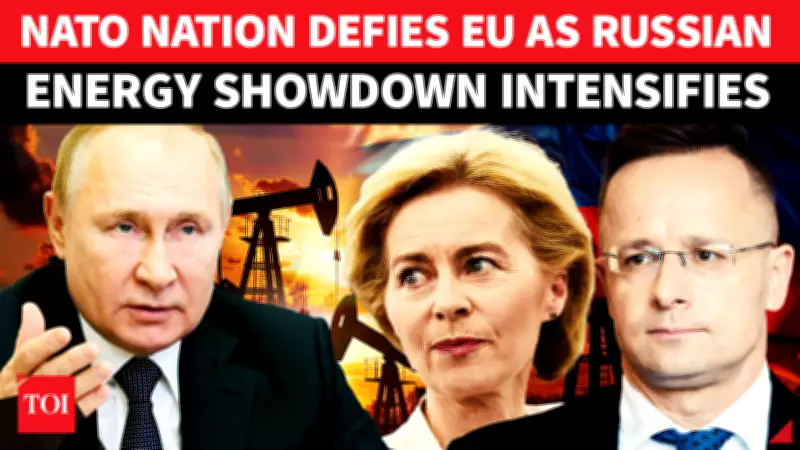
In a bold move that has sent shockwaves through European diplomatic circles, Hungary has openly declared its intention to defy Brussels on energy policy. The Central European nation has firmly stated it will continue purchasing Russian natural gas routed through Turkey, directly challenging the European Union's tightening restrictions on energy imports.
Budapest's Defiant Stance on Energy Security
Speaking from the capital Budapest, Hungarian Foreign Minister Péter Szijjártó delivered a clear message that has reverberated across the continent. He emphasized that without access to the Turkish Stream pipeline, Hungary's energy security would face significant risks. The minister's statements represent a direct confrontation with EU energy policies that have been implemented in response to geopolitical tensions.
"We will continue to purchase Russian natural gas through Turkey because our national energy security depends on it," Szijjártó declared, framing the issue as a matter of practical necessity rather than political alignment.

Legal Challenge Against EU Restrictions
Hungary has characterized the European Union's energy restrictions as "ideological interference" and "legal trickery," signaling its intention to mount a formal legal challenge. Budapest plans to contest the ban at the prestigious European Court of Justice, where it will be joined by Slovakia in what promises to be a landmark energy case.
This legal maneuver represents a significant escalation in the ongoing energy policy dispute between certain Central European nations and the broader European Union establishment. The case could establish important precedents regarding national sovereignty versus collective EU energy policy.
Deepening Hungary-Turkey Energy Partnership
As the European Union pushes for stricter energy regulations and reduced dependence on Russian resources, Hungary is moving in the opposite direction by strengthening its partnership with Turkey. This strategic alignment involves multiple dimensions:
- Expanding energy cooperation through the Turkish Stream pipeline
- Deepening bilateral trade relationships beyond energy
- Increasing mutual investments between the two nations
- Reinforcing Ankara's position as a critical energy corridor for Central Europe
The partnership represents a pragmatic approach to energy security that prioritizes reliable supply over political considerations, according to Hungarian officials.
Record Gas Imports and Rising Deliveries
Recent data reveals Hungary has been importing Russian natural gas at record levels, with daily deliveries showing a consistent upward trend. This practical reality underscores Budapest's argument that immediate energy needs must take precedence over longer-term political considerations.
The message from Hungarian leadership is unequivocal: when it comes to keeping homes heated and industries running, energy security must come before politics. This position reflects broader concerns in Central Europe about the practical implications of rapidly shifting energy policies.
Broader Implications for European Energy Policy
Hungary's defiant stance highlights the complex challenges facing European energy integration. While Western European nations push for reduced dependence on Russian energy, some Central European countries emphasize the practical difficulties and economic costs of such transitions.
The situation reveals fundamental tensions within the European Union regarding:
- The balance between collective security policies and national sovereignty
- The practical timeline for energy transition away from Russian sources
- The economic impact of energy policy changes on different member states
- The role of alternative energy corridors like Turkey in European energy security
As Hungary prepares its legal challenge and continues to import Russian gas through Turkey, the European energy landscape faces increasing fragmentation along geopolitical and practical lines.