Punjab Agricultural University (PAU) experts have detailed how the global climate phenomena El Niño and La Niña significantly influence the state's monsoon rainfall patterns, leading to droughts or floods, with climate change amplifying these extremes. With 2026 predicted as an El Niño year, there is a high probability of deficient rainfall, raising concerns for agriculture and water resources.
Understanding El Niño and La Niña
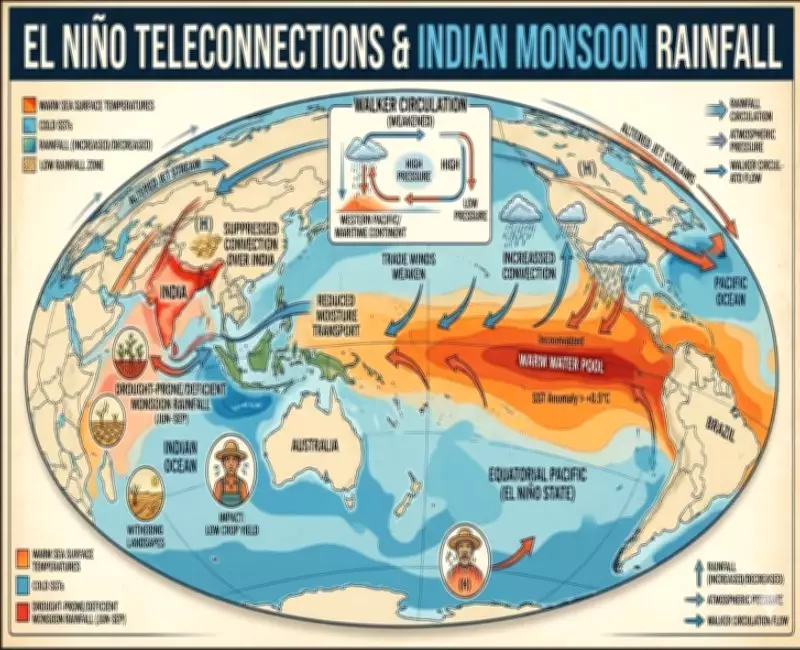
Kulwinder Kaur Gill, Principal Agrometeorologist at PAU's Department of Climate Change and Agricultural Meteorology, explained that El Niño involves unusually warm ocean surface temperatures along Peru's coast, disrupting trade winds and suppressing cloud formation over South Asia, often causing deficient rainfall in Punjab. Conversely, La Niña features stronger trade winds that push warm waters westward, enhancing rainfall over Asia and leading to surplus precipitation, sometimes resulting in floods.
The relationship is not always straightforward due to regional factors like atmospheric caps, soil moisture, and Himalayan influences, but the broad trend holds: El Niño years tilt toward drought, while La Niña years bring excess rain. Climate change is acting as a "force multiplier," making these cycles more erratic and extreme.

Punjab's Rainfall Trends and Recent Extremes
Punjab's average annual rainfall is 500 mm. Drought years are defined by a deficit of more than 19%, while flood years have a surplus exceeding 19%. Recent extremes include 2014 with 49% below normal (worst drought year), 2012 with 46% below normal, 2008 with 20% above normal, and 2025 with 41% above normal—a La Niña year with record-breaking rainfall.
In the past 25 years, Punjab experienced 13 drought years, 8 linked to El Niño, and only 3 excess rainfall years tied to La Niña. This imbalance shows the state is more vulnerable to drought than floods, though both are intensifying. The "normal" monsoon of 500 mm is becoming rare, replaced by cycles of climate extremes that disrupt traditional farming calendars.
Impact on Agriculture and Livestock
Higher temperatures during El Niño dry soils faster, stressing crops. Farmers are advised to shift to short-duration, drought-tolerant crops like millets (sorghum, bajra), pulses (pigeon pea, green gram), and oilseeds. Irrigation practices should transition from flood to drip or sprinkler systems, cutting water use by 30–50%, and irrigating at night or early morning to reduce evaporation. Intercropping, such as maize with pigeon pea, ensures income security, while mulching with straw or plastic sheets conserves moisture. Fertilizer management should avoid high urea doses, preferring foliar sprays like 2% KCl, and increase organic manure to boost water-holding capacity.
For livestock, early harvest and storage of dry fodder, silage preparation from excess green forage, mineral supplements to maintain immunity, and heat stress management with shade, cool water, and ventilation are recommended. Heat waves reduce milk yield, weaken immunity, and increase disease outbreaks.
Health Impacts of Monsoon Variability
Monsoon variability affects human health directly and indirectly. El Niño years bring prolonged heat, increasing dehydration, heatstroke, and respiratory stress. La Niña floods create breeding grounds for mosquitoes, raising risks of malaria and dengue. Dust storms and dry spells worsen asthma and bronchitis, while floods contaminate drinking water, spreading diarrhoeal diseases.
Historical El Niño and La Niña Years in Punjab
Data from the past 25 years shows El Niño years with rainfall in mm: 2002 (363.8), 2004 (280.4), 2007 (340.4), 2009 (326.6), 2014 (244.7), 2016 (353.9), 2023 (416.3), and 2024 (317.3). La Niña years include 2008 (603.7), 2018 (590.3), and 2025 (620.9).
Prabhjyot Kaur, Principal Scientist (Agrometeorology), stated, "Our farmers cannot control the Pacific, but they can prepare their fields. Adaptation is the only way forward." Harleen Kaur, Assistant Professor (Agricultural Meteorology) at PAU, warned that with 2026 predicted as an El Niño year, farmers may rely more on groundwater, further straining aquifers already depleted by decades of paddy cultivation.