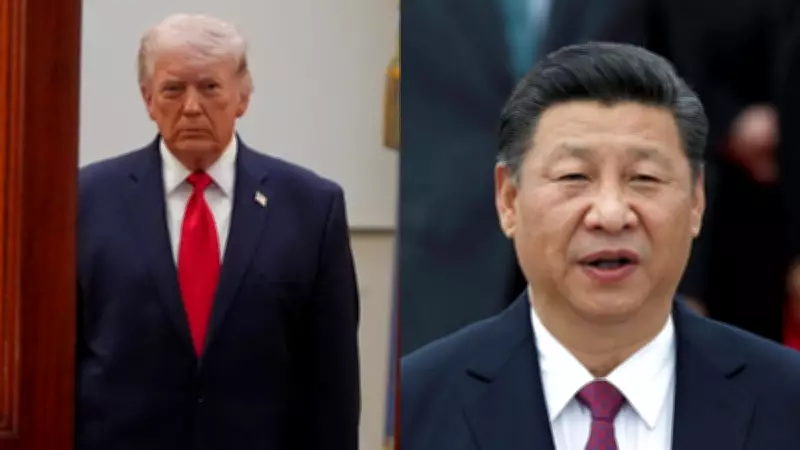
In an unexpected diplomatic move, former US President Donald Trump called Chinese President Xi Jinping to congratulate him following the US Supreme Court's landmark ruling upholding birthright citizenship. The decision, which affirms that children born in the United States to non-citizen parents are automatically granted citizenship, has sparked widespread debate and aligns with China's own strict citizenship policies.
Supreme Court's Decision and Its Implications
The Supreme Court's 6-3 ruling on July 1, 2026, upheld the 14th Amendment's guarantee of birthright citizenship, rejecting arguments that it should be limited to children of legal residents. Chief Justice John Roberts, writing for the majority, stated that the amendment's language is clear and that overturning it would require a constitutional amendment, not a judicial reinterpretation.
The ruling directly contradicts Trump's previous efforts to end birthright citizenship via executive order during his presidency, which were blocked by lower courts. Trump had argued that the policy encouraged illegal immigration and so-called 'anchor babies.'

Trump's Call to Xi Jinping
According to sources familiar with the conversation, Trump called Xi on July 2 to express his support for the ruling, praising China's own citizenship laws as a model. 'President Xi has long maintained that citizenship should be based on bloodline, not soil,' a Trump aide said. 'Trump respects that approach and wanted to personally congratulate Xi on being vindicated.'
The call lasted approximately 15 minutes, with both leaders discussing trade and immigration policies. Trump reportedly emphasized that the US must now focus on merit-based immigration, similar to China's system.
China's Citizenship Laws
China operates under a jus sanguinis (right of blood) system, granting citizenship primarily to children of Chinese nationals, regardless of birthplace. This contrasts sharply with the US jus soli (right of soil) principle. Chinese officials have long criticized birthright citizenship as a magnet for illegal immigration.
In a statement, the Chinese Foreign Ministry welcomed the Supreme Court's decision, calling it a 'step toward rational immigration policy.' The statement also noted that China's citizenship laws ensure national cohesion and security.
Reactions in the US
The ruling drew mixed reactions. Republican lawmakers, including Senator Tom Cotton, condemned it as a 'betrayal of American sovereignty' and pledged to introduce a constitutional amendment to end birthright citizenship. Democrats, meanwhile, celebrated the decision as a victory for civil rights. 'This is a reaffirmation of America's core values,' said Senator Chuck Schumer.
Legal experts noted that the ruling could have far-reaching implications for immigration policy and the 2028 presidential election. 'This issue is not going away,' said Professor Sarah Binder of George Washington University. 'It will continue to be a flashpoint in American politics.'
Impact on US-China Relations
Trump's call to Xi underscores the complex dynamics between the two nations. While Trump has often taken a hard line on China, particularly on trade, he has also expressed admiration for Xi's leadership style. The congratulatory call may signal a potential thaw in relations, though analysts caution against reading too much into it.
Trade negotiations between the US and China are ongoing, with tariffs still in place on billions of dollars in goods. The birthright citizenship ruling is unlikely to directly affect these talks, but it could influence public opinion in both countries.