

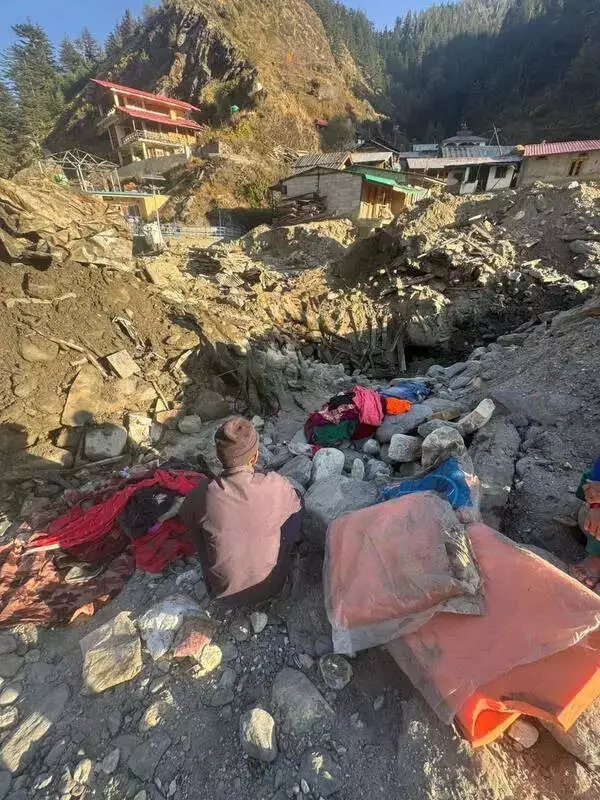
Four months after a devastating flash flood ripped through Dharali in Uttarakhand, the colossal debris it left behind presents one of the Himalayas' most daunting cleanup challenges. Experts now warn that the sheer scale, hardened composition, and treacherous terrain make a complete removal operation "nearly impossible."
A Landscape Turned to Concrete
The catastrophic event of August 5 transformed the serene landscape into a hardened, perilous zone. Massive mounds of tightly packed mud, boulders, and gravel remain untouched, having solidified into what responders describe as a "cement-like" terrain. This transformation occurred through repeated cycles of wetting and drying, which compacted the flood deposits into an incredibly dense mass.
NDRF Commandant Sudesh Kumar, who led a team of over 100 personnel at the site for more than a month, stated that even heavy earthmovers are ineffective against this solidified debris. "The flood deposits have become a dense, cemented mass that is extremely difficult and risky to penetrate," he explained.

Expert Warnings and Daunting Scale
Geologist Piyoosh Rautela, former executive director of the Uttarakhand State Disaster Management Authority (USDMA), highlighted severe risks associated with excavation. He cautioned that digging up the entire debris layer could trigger fresh hazards like stream blockages, secondary debris flows, and increased downstream pollution and silt loads.
Rautela also pointed to the grim challenge of recovering the missing, citing past tragedies in Malpa, Kedarnath, and Bastari. "There is no technology to pinpoint bodies inside such huge deposits. In earlier incidents, bodies buried under deep debris could not be recovered," he added. Official data states at least 52 people went missing in the disaster. Of these, 12 from Uttarkashi district have been declared dead, bringing the total death toll to 16.
The scale of the disaster is staggering. Field data from the Wadia Institute of Himalayan Geology reveals that approximately 250,000 tonnes of debris travelled from the upper catchment to Dharali at a velocity of about 9.1 metres per second, flattening structures and burying others. Rapid assessments by Isro's National Remote Sensing Centre (NRSC) show the debris has formed a massive fan-shaped deposit.
Prasoon Singh, a fellow at The Energy and Resources Institute (TERI), compared the scale to the 2021 Tapovan–Vishnuprayag disaster. He emphasized that a complete removal is "practically impossible," and only priority zones like residential areas or key road sections can be targeted for desilting, which itself would require a "mammoth" effort.
Community's Struggle and a Plea for Balanced Response
While experts survey the terrain and official responders focus on accessible areas, a resilient local community has taken matters into their own hands. Without waiting for government assistance, several families have begun digging with hand tools or spending personal savings to hire machines. In their desperate search for missing loved ones and remnants of their lives, residents have recovered items like cash, jewellery, utensils, and cooking gas cylinders.
As this painstaking work continues, social activist Dwarika Semwal calls for an official response that balances scientific advice with human compassion. "We need to listen to the experts and also heed what locals who have lost everything are saying," he urged. The path forward for Dharali remains fraught with difficulty, caught between the immovable force of nature's aftermath and the unwavering determination of its people.






