Rare Heart-Shaped Aurora Borealis Illuminates Norway's Sky in Romantic Pre-Valentine's Display
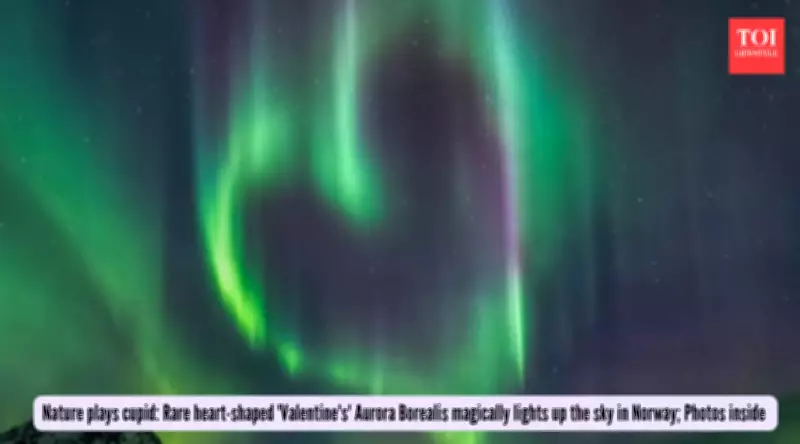
As the season of love approaches, nature itself appears to be joining the celebration. Just days before Valentine's Day, the sky over Norway delivered a breathtaking spectacle: a rare heart-shaped aurora borealis, captured in a single photograph that has become an overnight global sensation.
The Magical Capture That Went Viral
The image, taken by Norwegian photographer Kristoffer Vangen, shows the Aurora Borealis glowing with an unmistakable heart-like formation against a dark, clear night sky. The timing couldn't be more perfect, appearing just as Valentine's Day preparations begin worldwide. As the photograph spread rapidly across social media platforms, viewers from every corner of the globe found themselves questioning whether they were witnessing genuine natural magic or sophisticated artificial intelligence manipulation.
What makes this phenomenon particularly remarkable is that the universe continues to deliver romance in its most raw, unfiltered form, requiring no digital enhancements or technological tricks to captivate human hearts.

When and Where This Celestial Romance Occurred
The now-famous photograph was captured on a clear Friday night somewhere in Norway, where Vangen has repeatedly ventured in search of aurora displays. On his Instagram account, the photographer explained that he had spent years hoping "to capture the northern lights shaped as something. I imagined a bird, a tornado, or a skull or something like this."
Vangen revealed that while he had come close to capturing shaped auroras on previous occasions, the formations never appeared clean enough in the frame. "It's been close a few times, but I never felt the shape was clear enough, it just looked messy," he confessed. Last Friday, however, his patience and persistence finally paid off when he captured a perfectly defined aurora arc resembling a glowing heart, suspended just above a snow-dusted landscape.
How Nature Creates Such Mesmerizing Atmospheric Art
Auroras occur through a fascinating natural process where charged particles from space, typically originating from solar storms, collide with atoms and molecules in Earth's upper atmosphere. These energetic collisions excite atmospheric gases, causing them to release tiny bursts of light that create the shimmering ribbons of green, blue, purple, and occasionally red that we recognize as the northern lights.
Under precisely the right conditions of solar activity, wind patterns, and camera angles, these luminous ribbons can twist and form shapes that appear almost intentional. This particular heart-shaped display serves as nature's humble yet magnificent expression of love, perfectly timed for the romantic season.
Social Media Skepticism and AI Doubts
As the photograph gained viral momentum, a significant portion of viewers initially refused to believe its authenticity, suspecting either AI-generated artistry or heavy digital manipulation. Many users on platforms including Instagram and X commented that nature's displays rarely appear this "perfect," while others defended the image's reality, calling it "mindblowing" and declaring that "People who think this is AI don't know nature is more magical than they think."
Another enthusiastic observer wrote, "Even nature expresses God's love! I have no doubt that the photo is real and I am grateful for your dedication and for sharing something so rare." This division among viewers highlights both the increasing sophistication of digital manipulation tools and the enduring capacity of natural phenomena to astonish beyond belief.
Photographer's Response to Authenticity Questions
To address mounting doubts about the image's reality, Kristoffer Vangen responded publicly, first acknowledging that "in today's world, I think it's very understandable" that people question whether such remarkable images might be AI-generated. He then firmly stated, "no, it's not AI."

The photographer substantiated his claim by sharing his RAW file and detailing his editing process, emphasizing that nothing in his workflow fundamentally invented the heart shape from scratch. "Every photographer has different rules for themselves for what's allowed," Vangen noted, explaining that his primary aim remains preserving the authentic beauty of natural scenes rather than creating artificial enhancements.
This extraordinary celestial event serves as a powerful reminder that even in our technologically advanced era, nature retains the capacity to surprise and enchant us with displays that seem almost too perfect to be real. The heart-shaped aurora borealis over Norway stands as both a romantic prelude to Valentine's Day and a testament to the breathtaking artistry of our natural world.