Haryana to Establish Forest Land Bank to Mitigate Green Cover Loss
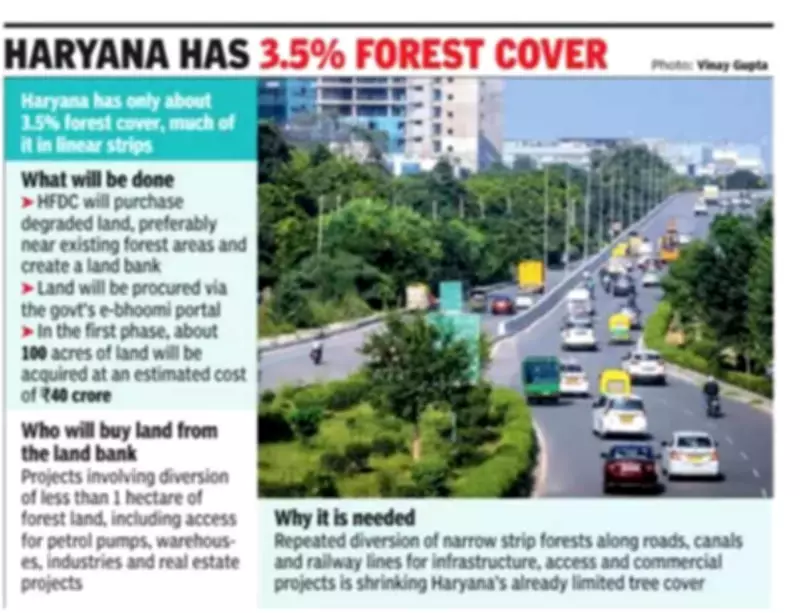
In a significant move to address the steady erosion of its already limited forest cover, the state of Haryana is planning to create a dedicated forest land bank. This initiative is designed to compensate for the loss of green cover resulting from the diversion of narrow forest strips along highways, canals, and railway lines for infrastructure and commercial projects.
Proposal by Haryana Forest Development Corporation
The proposal, prepared by the Haryana Forest Development Corporation (HFDC), suggests the creation of this land bank specifically for smaller projects that involve the diversion of forest land for non-forestry purposes. This falls under the provisions of the Van (Sanrakshan Evam Samvardhan) Adhiniyam, 1980. Once established, project proponents seeking to divert small patches of forest land—such as for access to petrol pumps, warehouses, industries, or real estate developments—will be required to purchase equivalent land from the HFDC.
Officials have indicated that the land will be procured through the government's e-bhoomi portal. A committee, headed by the managing director of HFDC, has been proposed to oversee the acquisition process. This committee will also include the APCCF (forest conservation)-cum-nodal officer under the forest conservation law, the conservator of forests for the south circle in Gurgaon as member secretary, and a representative from the land revenue department.

Phase One Acquisition and Cost Estimates
In the initial phase, the corporation plans to acquire approximately 100 acres, which is about 40 hectares, of land. The estimated cost for this acquisition is around Rs 40 crore. The primary purpose of this land bank will be to compensate for diversion proposals that involve less than one hectare of forest land. This targeted approach aims to address the cumulative impact of numerous small-scale diversions that have been occurring across the state.
Haryana's Forest Cover Context
Haryana currently has only about 3.5% forest cover, ranking among the lowest in the country. A substantial portion of this forest area exists as strip forests along roads, national highways, canals, bunds, and railway lines. These strip forests often constitute the primary tree cover in several districts, making their preservation critical for maintaining the state's ecological balance.
The proposal notes, "The forest area of strips, especially along roads, is being diverted either by widening of roads or by seeking access through the forest lands for non-forestry purposes such as petrol pumps, warehouses, industries, and development projects."
Data on Forest Land Diversion
Data shared by the Union Environment Ministry reveals that more than 1,150 hectares of forest land in Haryana were diverted for over 1,280 projects between April 2021 and October 2025. This indicates a consistent and growing pressure on the state's already limited forest resources. The issue was discussed at a meeting on March 9, where officials decided to adopt the forest land bank model, inspired by similar initiatives in Punjab, to manage the diversion of small parcels of forest land effectively.
Legal Framework and Exemptions
Under the Van (Sanrakshan Evam Samvardhan) Adhiniyam, 1980, the diversion of forest land for non-forest purposes typically requires prior approval from the central government. However, an amended provision provides a limited exemption for the diversion of forest land up to 0.10 hectare located alongside railway lines or public roads, provided it is used to grant access to habitations or basic roadside or rail amenities.
A forest official explained, "While the exemption applies to very small parcels, states like Haryana, where a large share of the remaining tree cover exists as roadside and canal strip forests, could see cumulative impacts over time."

Environmental Concerns and Expert Opinions
Environmentalists have raised concerns about the piecemeal diversion of strip forests. Vivek Kamboj, an environmentalist, emphasized, "Strip forests may look insignificant individually, but together they form the backbone of Haryana's green cover and act as critical buffers along roads and canals. The FCA exemption for small parcels has unintentionally encouraged piecemeal diversion, and over time this has led to a visible thinning of green cover. A land bank can help compensate for losses, but it should not become a substitute for protecting existing forests."
Mechanism and Future Implications
The proposed mechanism aims to ensure that multiple small diversions do not result in a permanent reduction in Haryana's forest cover, even as infrastructure expansion continues rapidly in districts such as Gurgaon and Faridabad. The HFDC plans to create the land bank by purchasing degraded land, preferably located near or contiguous to existing forest areas, to facilitate ecological restoration and connectivity.
Officials assert that this strategy is crucial for balancing development needs with environmental conservation, safeguarding the state's fragile green infrastructure for future generations.