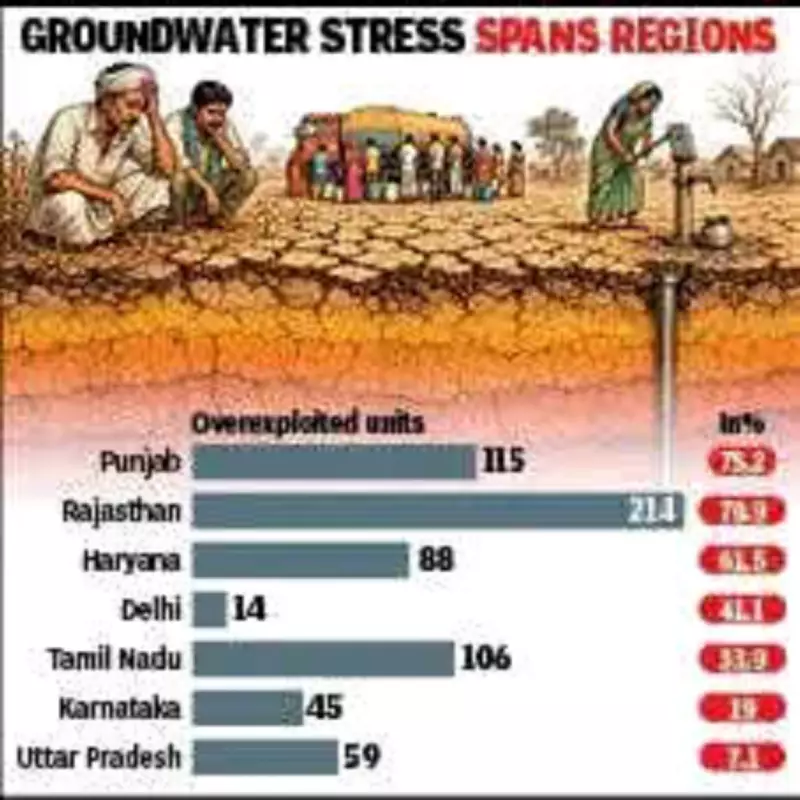
Haryana has emerged as India's third most groundwater-stressed state, with 88 assessment units classified as overexploited. This accounts for 61.5% of its groundwater blocks, according to Central Ground Water Authority (CGWA) data placed before the National Green Tribunal (NGT).
NGT pulls up states over weak enforcement
Pulling up states over weak enforcement against illegal extraction and inadequate recharge measures, the NGT has ordered a wider review. The CGWA data shows only Punjab, where 75.1% of groundwater units are overexploited, and Rajasthan, at 70.9%, fare worse than Haryana among major states. Haryana is followed by Delhi at 41.2%, Tamil Nadu at 33.87%, Karnataka at 18.99%, and Uttar Pradesh at 7.06%.
Suo motu hearing reveals nationwide failures
Hearing the matter suo motu, the NGT on Thursday noted serious nationwide failures in tackling groundwater depletion. A panel of chairperson Justice Prakash Shrivastava and expert members Dr. A. Senthil Vel and Dr. Afroz Ahmad said the states or union territories failed to take adequate steps to prevent illegal extraction of groundwater and to ensure recharge “where it has gone below the critical point”.

The order that came on Monday said although the ministry of Jal Shakti’s groundwater regulation guidelines and CGWA’s standard operating procedures were in place, they had not been effectively implemented. Despite the Haryana Water Resources (Conservation, Regulation and Management) Authority Act, 2020, which bars most new industrial groundwater extraction in overexploited zones and prohibits new packaged water or water-intensive industries, implementation gaps remain substantial in the state.
Haryana's enforcement actions
The government told the tribunal that till June 27, 2025, it issued 1,850 show-cause notices to industries, restaurants, dhabas, banquet halls, resorts and RO plants for violations. Of these, 413 cases were disposed of, around 155 units sought compliance, nearly 100 units voluntarily shut borewells and about 100 cases were referred for sealing. The environmental compensation charges imposed stood at Rs 4.88 crore.
Uttar Pradesh, on the other hand, had 59 overexploited units, but just 7.06% of total blocks, though it still issued 21,300 notices for illegal extraction and sealed 111 borewells.
Expert committee to address crisis
To address the crisis, the NGT said it was necessary to ensure effective compliance of the guidelines and to remediate the problem of over-extraction of groundwater and ensure its recharge. It constituted a five-member expert committee comprising representatives from National Geophysical Research Institute, Geological Survey of India, the environment ministry, IIT Roorkee and CGWA, which will be the nodal agency.
The panel has been tasked to identify state-wise lapses, recommend measures to prevent over-extraction in critically scarce zones and propose both general and state-specific groundwater recharge strategies within three months, before the next hearing on Aug 25, 2026.