

Gurgaon Bears 70% of Yamuna Pollution Load, But Multiple Haryana Districts Contribute to River's Collapse
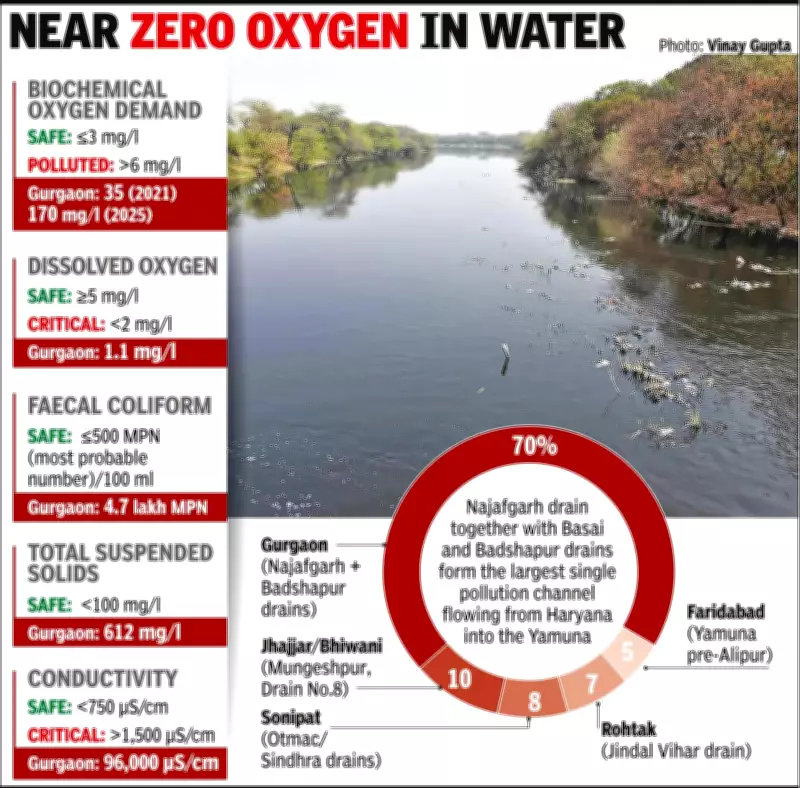
New data from the Haryana State Pollution Control Board (HSPCB) has revealed a disturbing pattern of pollution entering the Yamuna River from across Haryana. While Gurgaon alone accounts for nearly 70% of the pollution load, environmental monitoring between 2021 and 2025 shows that several other districts are contributing significantly to the river's deterioration long before it reaches Delhi.
The Stark Reality of Gurgaon's Pollution Contribution
Gurgaon's pollution impact on the Yamuna is both massive and alarming. The city's Najafgarh drain legs I, II and III, along with the Basai and Badshahpur drains, have remained the primary conduits of contamination into the river system. Monitoring data shows that Biochemical Oxygen Demand (BOD), a crucial indicator of organic pollution, has skyrocketed in Gurgaon's major drains from 35-45 mg/L in 2021 to a staggering 170 mg/L in 2025.
This represents nearly 50 times the safe river-water limit of 3 mg/L and far exceeds the 6 mg/L level typically associated with severe sewage pollution. Additional measurements reveal total suspended solids reaching 612 mg/L, while faecal coliform levels have climbed to 4.7 lakh MPN per 100 ml, indicating heavy discharge of untreated sewage into the water system.

The Expanding Pollution Network Beyond Gurgaon
While Gurgaon dominates the pollution statistics, the river's collapse before reaching Delhi is not the work of one district alone. Pollution board data reveals a widening chain of sewage and industrial discharge from Sonipat, Jhajjar, Bhiwani, and Faridabad as well, creating a heavily contaminated flow long before the river enters the capital.
Sonipat has emerged as a critical contributor due to its strategic position in the river basin. Data from drains such as Otmac and Sindhra shows BOD levels rising from 28-42 mg/L in 2021 to 110 mg/L in 2025. Unlike Gurgaon where sewage dominates, Sonipat's pollution appears more mixed, combining untreated urban wastewater, agricultural runoff, and partial discharge from sewage treatment plants.
Smaller Districts with Severe Chemical Impact
Jhajjar and Bhiwani discharge smaller volumes of wastewater compared to Gurgaon, but their chemical burden is particularly severe. In the Mungeshpur drain and drain No. 8, BOD levels rose to 72-145 mg/L by 2025, while hardness reached 4,450 mg/L, indicating industrial waste rich in dissolved salts that further degrades water quality.
Faridabad maintains a more stable but persistently polluted profile, with BOD ranging from 40 to 72 mg/L, conductivity staying above 2,000 S/cm, and faecal coliform rising to 24,000 MPN per 100 ml in 2025, showing continued sewage inflow into the river system.
The Cumulative Effect and Environmental Consequences
The combined pollution from these multiple entry points has created a devastating cumulative effect on the Yamuna. By mid-2025, dissolved oxygen had fallen to near zero in several stretches of Delhi, a level at which aquatic life cannot survive. This biological death of the river represents what environmental activists describe as a systemic failure rather than isolated lapses in pollution control.
Environmental activist Varun Gulati emphasized the interconnected nature of the problem, stating, "The Yamuna has been receiving untreated waste from multiple entry points. Even if one city improves treatment capacity, the cumulative load from neighbouring districts ensures the river remains biologically dead by the time it reaches Delhi."
Underlying Causes and Official Response
An HSPCB official attributed the worsening pollution numbers to pressure from rapid urbanization and weak sewer connectivity across the region. While interception and diversion works are reportedly underway, some drains continue to carry untreated wastewater directly into the river system.
The Badshapur drain in Gurgaon exemplifies the mixed nature of the pollution problem, with BOD climbing to 120 mg/L and conductivity touching 96,000 S/cm, suggesting a toxic blend of domestic sewage and industrial effluents. Similarly, in Rohtak, the Jindal Vihar drain adds approximately 7% of the pollution load into the river, according to survey data.

The monitoring data reveals a sharply uneven but cumulative pattern of pollution that has overwhelmed the Yamuna's natural recovery capacity. As urban development continues across Haryana's districts, the challenge of managing wastewater and industrial discharge becomes increasingly critical for the survival of one of North India's most important river systems.





