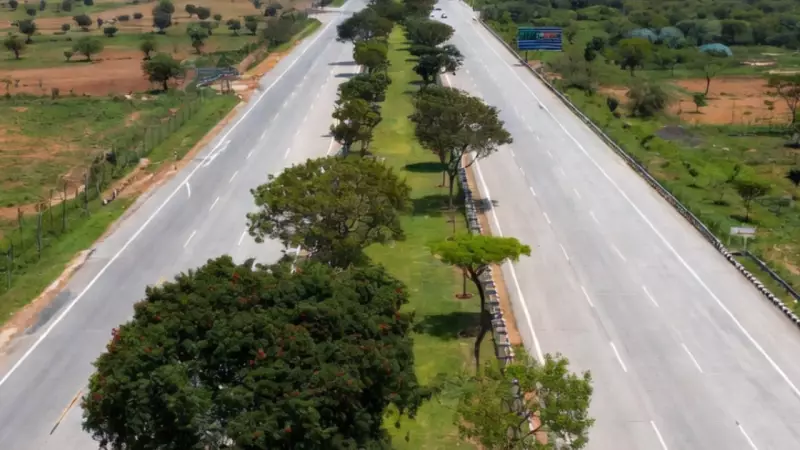
GURGAON: Eight years have passed since the Union Ministry of Environment, Forest and Climate Change (MoEFCC) granted approval for the diversion of 51.12 hectares of forest land to facilitate the construction of the Delhi-Mumbai Expressway along the Badshahpur to Sohna stretch. Despite this significant passage of time, critical details regarding compensatory afforestation (CA) efforts and adherence to stipulated approval conditions remain shrouded in ambiguity, raising serious environmental accountability questions.
The Legal Framework and Compliance Gaps
Under the provisions of the Forest (Conservation) Act, 1980, any project requiring forest land for non-forest purposes—such as highways, dams, mining, or transmission lines—must obtain formal diversion approval from the central government. A cornerstone of this approval process is the mandatory implementation of compensatory afforestation, designed to offset ecological loss through a 'land for land' and 'trees for trees' principle. This mechanism is intended to ensure that development does not come at the irreversible cost of India's dwindling forest cover.
However, in the case of the Delhi-Mumbai Expressway segment in Gurgaon, transparency and compliance appear to be lacking. While the local forest department has indicated that 42,468 saplings were planted in the Nuh division during the 2025-26 period as part of CA linked to this project, this information represents only a fragment of the complete picture. There is no comprehensive data available detailing the total afforestation carried out since the diversion was approved in August 2018. Crucially, the exact locations of these plantations, the survival rate of the saplings, and whether key conditions mandated in the Centre's approval letter have been met remain unanswered.

RTI Revelation and Incomplete Information
This concerning information gap came to light through a Right to Information (RTI) reply issued earlier this month by the Divisional Forest Officer (Territorial), Gurgaon. The accessed reply confirms that compensatory afforestation for the expressway project was proposed across two divisions: Nuh and Morni-Pinjore. It specifically notes that the DFO, Nuh, was responsible for planting the aforementioned 42,468 saplings. The reply also clarified that tree transplantation was not permitted by the MoEFCC and was consequently not undertaken.
Despite these details, the RTI response falls short of providing a complete account. It fails to specify the precise geographical sites where CA was implemented. Furthermore, it lacks a project-wise breakdown of the overall plantation effort against the sanctioned diversion. Most importantly, it omits critical data on the survival status of the planted trees and any monitoring reports that should document the health and progress of these compensatory green zones.
Activist Allegations and Regulatory Shortcomings
Environmental activist Vaishali Rana, who filed the RTI application, has raised several pointed allegations regarding the project's compliance. She contends that the information provided is incomplete, with no consolidated data revealing the total number of trees planted since the 2018 approval or verifying whether plantations were successfully established and survived in both the Nuh and Morni-Pinjore divisions.
Rana has also highlighted a potential violation of CA rules, alleging that plantations were carried out approximately 350 kilometers away in a different district, which may not constitute a legitimate ecological compensation for the loss incurred in Gurgaon. She further pointed to a specific condition in the diversion approval that required the user agency, the National Highways Authority of India (NHAI), to install 4-foot-high cement pillars at regular intervals to demarcate the CA plantation site. Rana alleges that on-ground compliance with this directive has not been properly verified by either NHAI or the forest department.

Expert Calls for Transparency and Haryana's Green Cover Crisis
Environmental experts emphasize that for major infrastructure projects like the Delhi-Mumbai Expressway, effective monitoring of compensatory afforestation is non-negotiable. They advocate for robust mechanisms including site-level public disclosure, geo-tagging of plantation sites, and periodic survival audits. These steps are essential to ensure that promised plantations translate into tangible, long-term ecological compensation and are not merely a paperwork exercise.
The urgency of proper CA implementation is underscored by Haryana's precarious green cover status. With only 3.6% forest cover, Haryana ranks among the states with the lowest green cover in India. Data from the Forest Survey of India reveals a troubling trend: Gurgaon itself lost 2.47 square kilometers of forest cover between 2019 and 2020. During the same period, the state's total tree cover outside formally recorded forest areas declined by a significant 140 square kilometers.
This case is not an isolated incident. Previous reports have indicated that plantation drives linked to forest diversions for multiple projects in the Gurgaon district have remained pending for years. Officials have often cited the non-availability of suitable land within the district for large-scale compensatory afforestation as a primary challenge, further complicating the quest for ecological balance in the face of rapid infrastructure development.