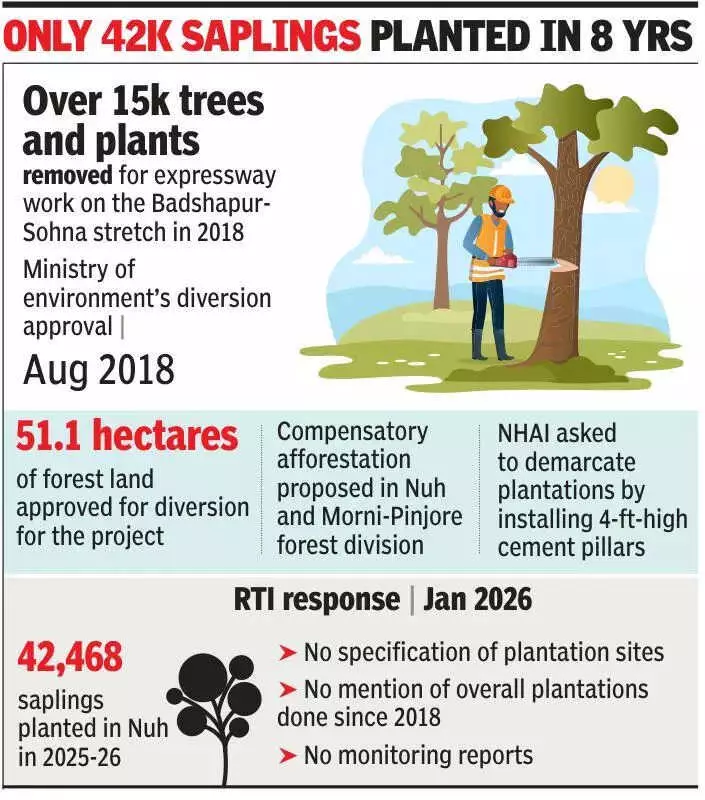
Eight years have passed since the Union environment ministry approved the diversion of 51 hectares of forest land for the Delhi-Mumbai Expressway between Badshapur and Sohna in Gurgaon. Yet, critical details regarding compensatory afforestation and compliance with key approval conditions remain shrouded in uncertainty.
The Forest Diversion Framework and Its Requirements
Under the Forest (Conservation) Act of 1980, when infrastructure projects such as highways require forest land for non-forest purposes, formal diversion occurs only after central approval. A cornerstone of this approval process is compensatory afforestation, which mandates compensating for the loss of land with equivalent land and replacing lost trees with new plantations.
It has been reported that approximately 16,000 trees and plants were lost on this specific stretch. While the forest department has indicated that 42,468 saplings were planted in the Nuh division during 2025-26 as part of the compensatory afforestation linked to the project, significant gaps persist in the overall record.

RTI Revelation Highlights Information Gaps
The information emerged through a Right to Information reply sent earlier this month by the District Forest Officer (Territorial) in Gurgaon. According to the reply, compensatory afforestation for the project was proposed in both the Nuh division and the Morni-Pinjore division. The DFO Nuh planted 42,468 saplings in the Nuh division in 2025-26.
The reply also clarified that tree transplantation was not permitted by the Ministry of Environment, Forest and Climate Change and, consequently, was not undertaken. However, the response fails to specify the exact locations of the compensatory afforestation sites or provide a comprehensive, project-wise breakdown of the total plantations carried out since the diversion approval in 2018.
Crucially, there is no information on the survival status of these plantations or any monitoring reports, leaving a void in accountability.
Approval Conditions and Alleged Non-Compliance
The diversion was cleared by the MoEF through an approval letter dated August 9, 2018, which included specific compliance conditions. These conditions mandated the demarcation and monitoring of compensatory afforestation plantations to ensure ecological compensation is effectively realized.
Environmental activist Vaishali Rana, who sought these details through the RTI, has raised serious concerns. She alleges that the information provided remains incomplete, with no consolidated data on the total number of trees planted since the approval or verification of whether plantations were undertaken and survived in both the Nuh and Morni-Pinjore divisions.
Rana further pointed out that compensatory afforestation plantations were reportedly carried out approximately 350 kilometers away in a different district, which she claims violates the established rules for such compensatory measures.
On-Ground Verification and Monitoring Deficiencies
Rana also highlighted a specific condition in the diversion approval that directed the user agency, the National Highways Authority of India, to install 4-foot-high cement pillars at regular intervals to demarcate the compensatory afforestation plantation site. She alleges that on-ground compliance with this directive has not been properly verified by either the user agency or the forest department.
Experts emphasize that monitoring compensatory afforestation for major infrastructure projects necessitates site-level public disclosure, geo-tagging of plantations, and periodic survival audits. These measures are essential to ensure that plantations translate into genuine ecological compensation and not merely paperwork exercises.
The Broader Context of Haryana's Green Cover
Haryana, with a forest cover of just 3.6%, ranks among the states with the lowest green cover in India. According to the Forest Survey of India, Gurgaon alone lost 2.47 square kilometers of forest cover between 2019 and 2020. During the same period, the state's total tree cover outside forest areas declined by 140 square kilometers.

This case is not isolated. Previous reports have indicated that plantation drives linked to forest diversions for multiple projects in Gurgaon have remained pending for years. Officials have often cited the non-availability of suitable land within the district for large-scale compensatory afforestation plantations as a primary challenge.
The ongoing ambiguity surrounding the Delhi-Mumbai Expressway project underscores the persistent difficulties in ensuring transparent and effective environmental compensation amidst rapid infrastructure development.