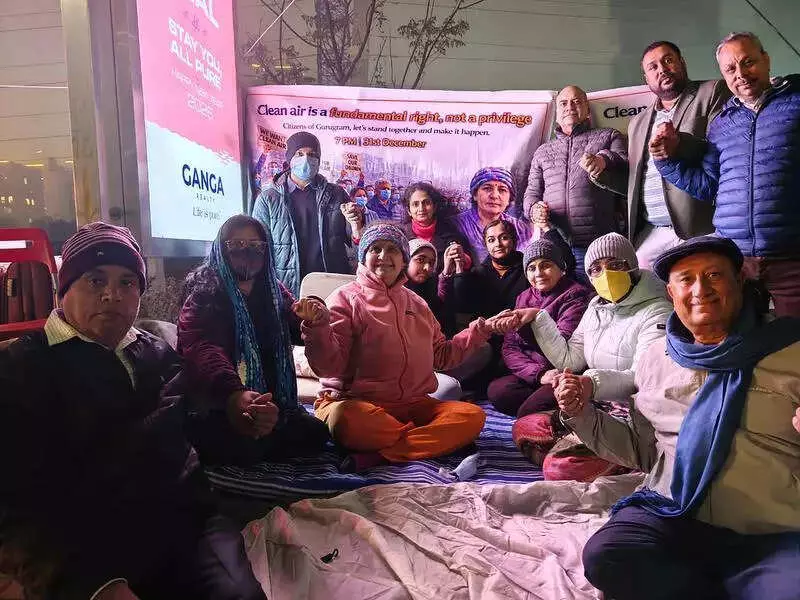
A protest against dangerously high levels of dust and deteriorating air quality in Gurgaon, spearheaded by activist Gauri Sarin, has now entered its second day. The demonstration, which began on Wednesday, is scheduled to conclude on Friday, aiming to spotlight what participants describe as years of official neglect towards a critical public health hazard.
Residents Decry "Dust Bowl" Corridors
The agitation zeroes in on the severe dust pollution plaguing major arteries, specifically Golf Course Road and the Southern Peripheral Road (SPR). Local residents have consistently identified these zones as major health risks, a situation exacerbated by prolonged construction activities and a glaring absence of effective dust-control protocols. "That whole corridor has turned into a dust bowl," stated Sarin, emphasizing the gravity of the issue. She revealed that the problem has been brought to the attention of multiple civic agencies repeatedly over the past three years, yet no lasting solution has been implemented.
An Unbroken Fast for Cleaner Air
In a powerful act of protest, Gauri Sarin initiated an indefinite hunger strike. She began her fast at 7 pm on December 31 and has maintained it without interruption. While she joins the physical protest site for approximately two hours each day, her fast continues throughout. "I am the only one observing the fast, though many residents are supporting the protest," she informed The Times of India. Her solitary fast stands as a stark symbol of the community's frustration.

Community Solidarity and Core Demands
Showing strong support for the cause, residents organized candlelight sit-ins at 7 pm on both Wednesday and Thursday. These gatherings took place opposite Bikanervala in Sector 57. The protestors have a clear set of demands for the authorities, calling for the strict enforcement of basic mitigation measures to curb the dust menace. Their key requirements include:
- Proper covering of all construction debris and material.
- Regular and frequent water sprinkling on roads and construction sites.
- Effective barricading of project sites to contain dust.
- Timely completion of infrastructure projects to prevent unnecessary prolonged exposure.
Sarin attributed the persistent problem to several civic failures, citing incomplete works by the GMDA and MCG, uncovered construction material, damaged pedestrian pathways, and uprooted trees as significant contributors to the airborne dust. The protest aims to transform this long-standing grievance into urgent, actionable policy for the health of Gurgaon's citizens.