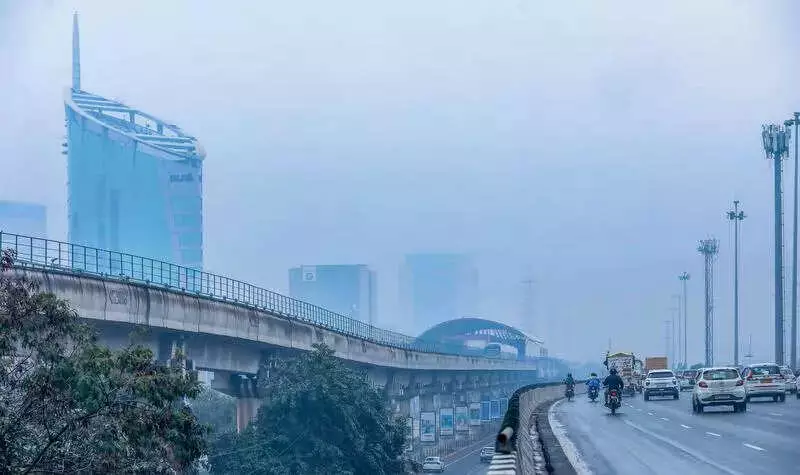
Gurgaon's air quality deteriorated further on Tuesday, with the city's Air Quality Index (AQI) touching 306, pushing it firmly into the 'very poor' category. This alarming spike occurred as fine particulate matter continued to accumulate under persistently weak dispersion conditions that have plagued the region.
Sharp Spatial Variations Across Monitoring Stations
Station-wise data revealed significant spatial variation across different parts of Gurgaon. Sector 51 recorded the worst air quality, remaining consistently in the upper 'very poor' range throughout the day. Meanwhile, monitoring stations at Vikas Sadan and Gwalpahari showed slightly better but still concerning readings, staying within the 'poor' category. Three of the city's four monitoring stations remained operational during this period, providing comprehensive data on the pollution levels.
January's Sustained Pollution Pattern
The month of January has witnessed sustained particulate pollution, with PM2.5 emerging as the dominant pollutant on most days. The AQI calendar for the month reflects repeated spikes into 'very poor' levels, particularly between January 9 and 22, indicating prolonged exposure to hazardous air for Gurgaon residents. This pattern highlights the persistent nature of winter pollution in the region.

Meteorological Factors Contributing to Poor Air
Officials attributed the latest deterioration to specific meteorological conditions, including low wind speeds and stagnant local atmospheric conditions that prevented pollutants from dispersing effectively. With no active weather system aiding ventilation, emissions from various sources—including traffic, construction activity, and other local pollution generators—continued to build up near the surface, creating a toxic blanket over the city.
Health Implications of 'Very Poor' Air Quality
According to established health advisories, air quality in the 'very poor' category can trigger respiratory discomfort even among healthy individuals during prolonged exposure. People with pre-existing respiratory conditions, cardiac issues, or other health vulnerabilities face significantly higher risks when breathing such polluted air. The Central Pollution Control Board (CPCB) categorizes air quality index levels between 0 and 50 as 'good', 51 to 100 as 'satisfactory', 101 to 200 as 'moderate', 201 to 300 as 'poor', 301 to 400 as 'very poor', and 401 to 500 as 'severe'.
Limited Impact of Recent Weather Events
Decision Support System (DSS) observations showed that despite light rain accompanied by thunderstorms and gusty winds recorded in parts of the National Capital Region (NCR) on Tuesday forenoon, meteorologists confirmed that dispersion remained limited due to overall weak ventilation conditions. This indicates that isolated weather events provide only temporary relief without addressing the underlying atmospheric stagnation.
Forecast Points to Continued Poor Air Quality
Weather forecasts indicate generally cloudy conditions over the next few days, with shallow to moderate fog expected during morning hours. Wind speeds are predicted to largely remain below 10 kmph during evenings and nights, offering little relief for pollutant dispersion. Predicted mixing depths are expected to range between 650 metres on Tuesday and 1,100 metres by Thursday, while the ventilation index is likely to stay well below the favourable threshold of 6,000 m²/s. These parameters signal continued poor dispersion of pollutants in the coming days.
DSS Outlook for Air Quality Categories
The DSS outlook pegs air quality in the 'very poor' category on Tuesday, with marginal improvement to 'poor' expected on Wednesday and Thursday. However, the forecast indicates a slip back to 'very poor' levels on Friday. Overall, air quality across the Gurgaon region is expected to remain in the 'poor' to 'very poor' range over the coming days unless stronger winds or sustained rainfall set in to cleanse the atmosphere.

PM2.5 Remains Dominant Pollutant
Fine particulate matter (PM2.5) is expected to remain the dominant pollutant in Gurgaon's air, underscoring a persistent winter build-up driven by local emissions and unfavourable meteorological conditions. This microscopic pollution poses particular health risks as it can penetrate deep into the respiratory system and enter the bloodstream, causing both short-term and long-term health effects.