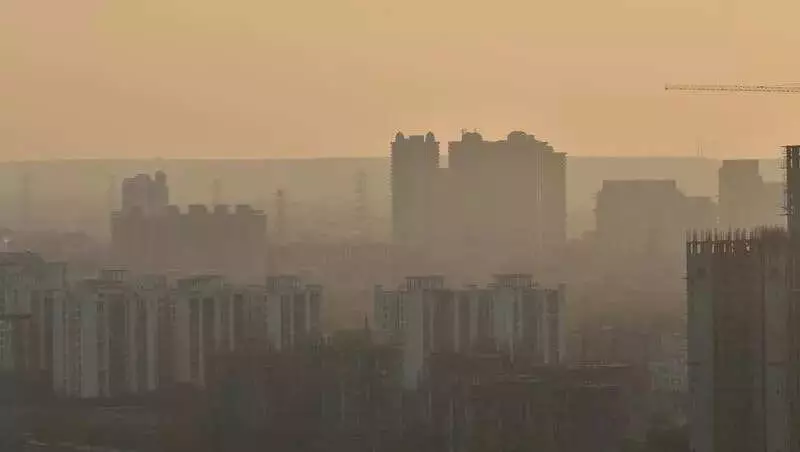
After grappling with 'very poor' air earlier in the week, Gurgaon witnessed a marginal improvement in its air quality on Monday, though it remained firmly within the 'poor' category. The city's overall Air Quality Index (AQI) settled at 240, according to data from the Central Pollution Control Board's (CPCB) Sameer application.
Tracking the AQI Fluctuations
The recent days have seen significant swings in pollution levels. On January 4, the AQI was a concerning 333, which improved to 244 on January 3. The week began with a relatively better AQI of 187 on January 2, highlighting the volatile nature of air quality in the region.
A closer look at data from the four monitoring stations paints a varied picture across the city:

- Sector 51 and Vikas Sadan both recorded air in the 'poor' band, with AQIs of 288 and 254 respectively.
- Teri Gram also reported 'poor' air with an AQI of 213.
- NISE Gwalpahari fared slightly better, registering a 'moderate' AQI of 198.
Health Risks and Weather Forecast
Health experts have reiterated that air quality categorized as 'poor' can lead to breathing discomfort upon prolonged exposure. This is particularly risky for individuals with existing respiratory conditions, the elderly, and young children. Residents are advised to monitor real-time AQI levels and avoid strenuous outdoor activities during pollution spikes.
The Decision Support System (DSS) for Delhi-NCR has projected that the region's air quality will largely oscillate between the 'poor' and 'moderate' brackets over the coming days. A fresh deterioration is likely later in the week. Specifically, the DSS estimates an improvement to 'moderate' on January 6, followed by a slip back to 'poor' on January 7 and 8. The six-day outlook suggests air quality may degrade further into the 'very poor' range thereafter.
Meteorological Factors at Play
The forecast from January 6 to 8 predicts mainly clear skies with shallow morning fog. Daytime maximum temperatures are expected to hover between 18°C and 20°C, while nighttime minimums will range from 6°C to 8°C, dipping to 5-7°C on January 8. Winds will predominantly blow from the northwest at speeds of 8-22 kmph during the day, weakening in the evenings.
Critical atmospheric parameters indicate challenging conditions for pollution dispersion. The DSS projects maximum mixing depths of about 1,000-1,150 metres from January 5 to 8. More importantly, the ventilation index is expected to drop sharply from around 6,500 m²/s on January 5 to approximately 3,800 m²/s on January 8. A ventilation index below 6,000 m²/s, coupled with low wind speeds, is considered unfavourable for dispersing pollutants, meaning they are likely to accumulate and linger in the air.
Meanwhile, in the national capital, stronger winds provided some relief. Delhi's AQI receded from the 'very poor' to the 'poor' category, recording 244 at 4 pm on Monday compared to 307 a day earlier. The India Meteorological Department (IMD) noted that wind speeds reached 15 kmph around Monday afternoon with consistent south-westerly winds, which aided in dispersing accumulated pollutants. There is a hopeful forecast that Delhi might see 'moderate' air quality readings on Tuesday.