Gujarat's Tiger Triumph: Reclaiming Big Cat Status After 33 Years
In a remarkable wildlife achievement, Gujarat has officially reclaimed its status as a tiger-bearing state, ending a 33-year absence of these majestic predators within its borders. This development not only marks a significant conservation milestone but also establishes Gujarat as India's sole state to host all three big cat species: tigers, leopards, and the iconic Asiatic lions.
The Unexpected Arrival in Jambughoda Forest
On a serene winter morning in the Jambughoda Wildlife Sanctuary of Panchmahal district, sunlight filters through dense bamboo, mahua, and teak trees. The tranquility of this Central Gujarat forest was recently disrupted by an extraordinary event: the arrival of a Royal Bengal Tiger in February of last year. Forest officials first detected clues of this new presence when a rescued leopard exhibited unusual nervousness, refusing to leave its forest cage and darting for cover upon release.
Ten days later, camera traps confirmed the reason for the leopard's anxiety, capturing clear images of a four-year-old tiger that had traversed approximately 60 kilometers from Madhya Pradesh's Katthiwada Wildlife Sanctuary into Gujarat's Kanjeta range. This migration through the Ratanmahal corridor represents one of the most intact forest patches in the state, characterized by minimal human population and adequate prey availability.

Historical Context and Current Significance
Gujarat's relationship with tigers has been tenuous for decades. As Gujarat's Forest and Environment Minister Arjun Modhwadia explained, "In 1989, tiger pugmarks were spotted but no actual tiger was seen. By the 1992 Tiger Census, Gujarat lost its status as a tiger state." A brief sighting in Mahisagar district in 2019 offered temporary hope, but that tiger survived only 15 days. The current tiger's sustained presence for over a year represents a substantial breakthrough.
Jaipal Singh, Gujarat's Principal Chief Conservator of Forests for Wildlife, emphasizes the corridor's suitability: "The dense 90-kilometer corridor from Kanjeta to Kevdi and further to Jambughoda is well-suited for tiger conservation. We have maintained water sources, and several caves in the Kanjeta forest division are particularly attractive to tigers."
Comprehensive Conservation Strategy
Forest authorities have implemented a multi-faceted approach to ensure the tiger remains in Gujarat:
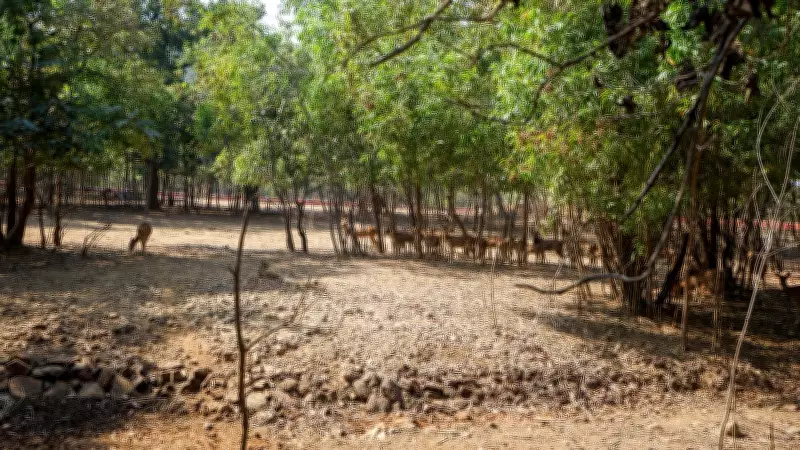
- Enhanced Prey Base Development: The Herbivore Breeding Centre established in 2024 near Kada dam represents a cornerstone of this strategy. With two specialized enclosures spanning 555 and 250 square meters respectively, the center houses approximately 50 chital deer and 33 sambar deer, carefully managed to boost wild populations.
- Infrastructure Protection: The breeding facility features 15-foot-tall fences, galvanized iron sheets, and electrified barbed wire specifically designed to prevent leopard intrusion. Officials have even pruned surrounding trees to eliminate climbing opportunities for these agile predators.
- Strategic Animal Releases: Recent months have seen increased activity as officials prepare to release 15 captive sambar deer into the wild, following successful previous releases of 22 sambars in the Ratanmahal area and six spotted deer in the Kanjeta division.
Future Challenges and Opportunities
The tiger's continued exploration of new territories presents both opportunities and challenges. The animal has reportedly begun moving closer to Makhaniya Dungar in Chhota Udepur district, an area known for its leopard population and natural caves. Among local communities accustomed primarily to leopards, excitement mingles with apprehension about this new predator.
Officials recognize that providing a mate for the solitary tiger represents their next significant challenge. A formal request has been submitted to the National Tiger Conservation Authority to identify a suitable companion, with expectations that the NTCA will respond following the ongoing tiger census. Senior forest officials express hope for establishing a population of three to four additional tigers, including multiple females.

Ecosystem Validation and Coexistence
The tiger's sustained presence serves as validation for Gujarat's forest management efforts. A.P. Singh, Principal Chief Conservator of Forest & Head of the Forest Force for Gujarat, notes: "These include planting fruit trees and creating water holes and caves across the corridor." Remarkably, camera trap images reveal that other predators, including sloth bears and leopards, have begun sharing water sources with the tiger, indicating gradual ecosystem adjustment.
Road safety remains a concern, particularly after recent sightings of the tiger crossing highways in the Kevdi forest range. Forest officials have conducted site visits to assess and mitigate this threat, emphasizing their commitment to keeping the tiger away from dangerous roadways.
As Gujarat celebrates this conservation achievement, the state's forest department maintains vigilant monitoring through daily updates and coordinated tracking across Central Gujarat ranges. This tiger's journey represents not just the return of a species, but the successful implementation of comprehensive wildlife management strategies that benefit entire ecosystems.