

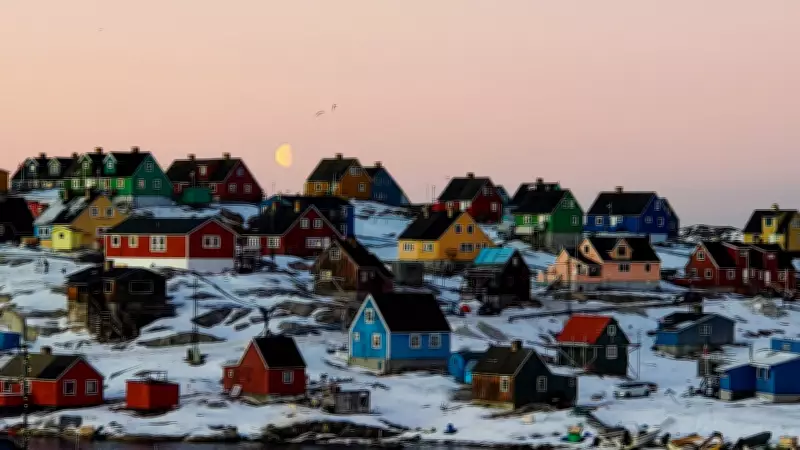
Greenland: The World's Largest Island Emerges as a Global Focal Point
Once perceived as a remote and forbidding expanse of ice, Greenland has quietly evolved into one of the most closely monitored locations on Earth. This transformation captures the interest not only of scientists and climate researchers but also of major global powers, drawn by its environmental significance and strategic value.
A Vast and Sparsely Populated Landmass
Greenland holds the title of the world's largest island, a vast, ice-dominated territory situated between the Arctic Ocean and the North Atlantic Ocean. It lies northeast of Canada and northwest of Iceland, comprising the main island—larger than any other on the planet—and over a hundred smaller surrounding islands. The island shares a mere 1.2-kilometre land border with Canada on Hans Island.
Despite its immense size, Greenland has a surprisingly small population of approximately 56,000 people. About one-third of these residents live in the capital city, Nuuk, with the majority of settlements concentrated along the coastlines. The interior remains largely uninhabited due to its icy terrain.

The Dominance of Ice and Unique Geology
Approximately 84% of Greenland is covered by a permanent ice sheet, the second-largest in the world after Antarctica's. This ice sheet can reach thicknesses of up to 3 kilometres, pressing the underlying bedrock below sea level. Only the coastal areas, characterized by mountainous, rocky, and barren landscapes, are ice-free.
Geologically, Greenland is exceptionally unique. It rests on the Greenland Plate, a sub-plate of the North American Plate, and contains some of the world's oldest rocks. The Isua greenstone belt in southwestern Greenland, dating back 3.7 to 3.8 billion years, offers geologists invaluable insights into Earth's earliest history.
The island's terrain is stark: a vast icecap slopes gradually from the interior toward the coasts, where jagged mountains rise sharply. Greenland's highest point, Gunnbjørn Fjeld, stands at 3,694 metres, making it the tallest mountain in the Arctic. Vegetation is sparse, dominated by tundra in most ice-free areas. The only naturally forested region is the Qinngua Valley in the far south, protected by surrounding mountains and just warm enough in summer to support tree growth.
Climate Variations and Coastal Influences
Greenland's climate ranges from arctic to subarctic, featuring short, cool summers and long, cold winters. Coastal areas benefit from a slightly more moderate climate due to the Gulf Stream, resulting in average winter temperatures in Nuuk around −9°C—much warmer than similar Arctic regions like Iqaluit in Canada. However, summers remain quite cool, with average temperatures of about 10°C, which is insufficient to support extensive tree growth.
The Impact of Climate Change
If Greenland were merely a frozen island at the top of the world, global interest might remain limited. However, climate change has propelled it into a critical focal point. The Greenland ice sheet is so massive that significant melting could have global consequences, including rising sea levels.
Scientists have uncovered remarkable features beneath the ice, such as Greenland's Grand Canyon, hidden for millennia. Evidence suggests that Greenland may not be a single island beneath the ice but potentially three separate landmasses, divided by bedrock basins below sea level. If massive melting occurs, these basins could fill with water, drastically altering Greenland's geography and contributing to worldwide sea-level rise.
In recent years, Greenland's three largest outlet glaciers—the Jacobshavn Isbræ, Kangerdlugssuaq, and Helheim glaciers—have experienced periods of rapid acceleration. Satellite data links these movements to increased seismic activity, with glaciers generating earthquake swarms as they shift. Climate change has also revealed new land; in 2005, an island named Uunartoq Qeqertaq, meaning "warming island" in Inuit, emerged from retreating ice, having previously been considered part of the mainland.
A Treasure Trove of Natural Resources
Beyond its climate significance, Greenland is of prime importance due to its abundant natural resources. The island boasts deposits of:

- Zinc and lead
- Iron ore and coal
- Gold and platinum
- Uranium and rare earth minerals
- Graphite, copper, tungsten, titanium, and vanadium
Additionally, Greenland has immense hydropower resources and rich fishing grounds. Rare earths, in high demand for high-tech industries, renewable energy, and military applications, are of particular interest. Gold deposits have been discovered in southern areas around Nanortalik, while diamonds have been found near Maniitsoq. Much of Greenland, especially the northeast and central east regions, remains largely unexplored.
Why the World is Watching Greenland
The international focus on Greenland intensified in 2019 when former U.S. President Donald Trump proposed that the United States might be interested in "buying" Greenland. Although this idea was quickly dismissed by Denmark and the Greenlandic government, it highlighted Greenland's longstanding geopolitical importance.
The United States has viewed Greenland as strategically valuable since the 19th century, particularly after the purchase of Alaska in 1867, which underscored the Arctic's role in transatlantic defence and communication. During the Cold War, Greenland became crucial in military strategies, and its location—connecting North America to Europe—remains of strategic value in the modern Arctic.
With ice melting and Arctic passages opening, Greenland's location, assets, and stability have gained prominence. Climate change has transformed Greenland from a remote, icy land into a major player in international debates on the environment, security, and future resource availability.
Known as Kalaallit Nunaat or "the Land of the People" in Greenlandic, Greenland continues to be a sparsely populated and unique place. Yet, it is increasingly at the forefront of global discourse. The ice caps hold secrets of Earth's past and portents of its future, while its natural resources offer economic development potential. Situated at the intersection of continents, Greenland stands as a pivotal region in today's world.





