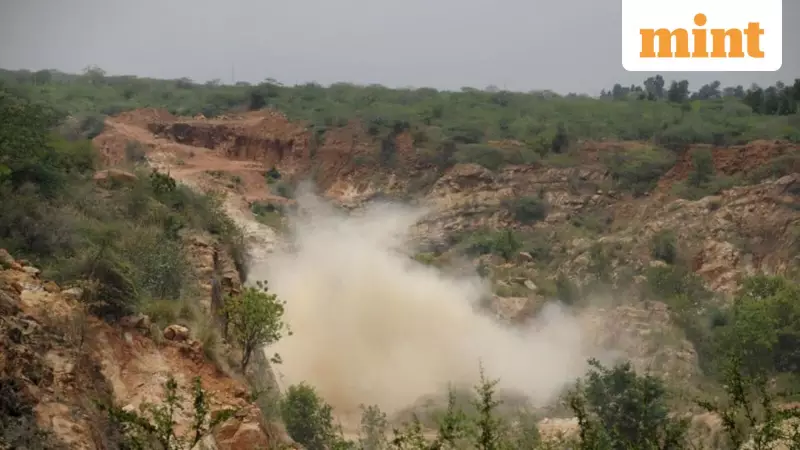
The central government moved on Monday to address growing concerns about potential ecological harm to the ancient Aravalli hills, asserting that the region faces no immediate threat and that mining activities will continue under stringent control. The assurance comes amid a heated debate following a recent Supreme Court order related to the definition and conservation of the range.
Clarity on Supreme Court's Aravalli Definition
Union Environment Minister Bhupendra Yadav addressed what he called widespread misinterpretation of the Supreme Court's order dated 20 November. The court accepted a committee's recommendation defining an "Aravalli Hill" as any landform in designated districts with an elevation of 100 metres or more above its local relief. An "Aravalli Range" is defined as a collection of two or more such hills within 500 metres of each other.
Yadav clarified that the 100-metre measurement refers to the hill's spread from top to bottom, and gaps between two ranges will also be considered part of the protected area. "With this definition, 90% of the area comes under the protected zone," he stated, dismissing circulating information as misleading.

Strict Regulation and Sustainable Mining Plan
The minister underlined that mining in the ecologically sensitive region remains tightly regulated. He announced that no fresh licences for mining will be granted until a comprehensive district-wise Management Plan for Sustainable Mining (MPSM) is prepared for the entire Aravallis by the Indian Council of Forestry Research and Education (ICFRE).
"After that, permission from ICFRE will be required before any activity can proceed," Yadav said, noting the Supreme Court has also directed the preparation of such a plan. He provided context, stating that at present, mining activity is limited to only about 277.89 square kilometres of the total Aravalli region spanning 1,43,577 square kilometres.
Reiterating the government's commitment, Yadav said, "The Aravallis will be safeguarded for present and future generations while balancing conservation with responsible development." He explicitly ruled out mining in the National Capital Region (NCR), stating, "The question doesn't even arise."
Addressing Delhi's Air Quality Challenge
Shifting focus to the national capital's persistent air pollution, Minister Yadav acknowledged the issue requires long-term strategy. While noting improvements on several days, he said adverse meteorological conditions in December continue to pose challenges.
He explained that western disturbances sometimes bring beneficial rain, but when they pass without precipitation, wind speeds drop, trapping pollutants like PM2.5 and PM10. On Monday morning, Delhi's overall Air Quality Index (AQI) was recorded at 366, in the 'very poor' category.
Outlining the government's multi-pronged approach, Yadav highlighted actions including:
- Traffic decongestion plans for about 62 identified severe choke points.
- Ensuring piped natural gas supply to industries.
- Deploying sweeping machines to control dust.
- Collaborating with neighbouring states on detailed action plans.
- Formulating new Solid Waste Management Rules for urban areas.
The Aravalli range, one of India's oldest geological formations, stretches across Delhi, Haryana, Rajasthan, and Gujarat. It serves as a critical barrier against desertification, protects biodiversity, and aids groundwater recharge. The Supreme Court has previously warned that uncontrolled mining there poses a "great threat to the ecology of the nation."