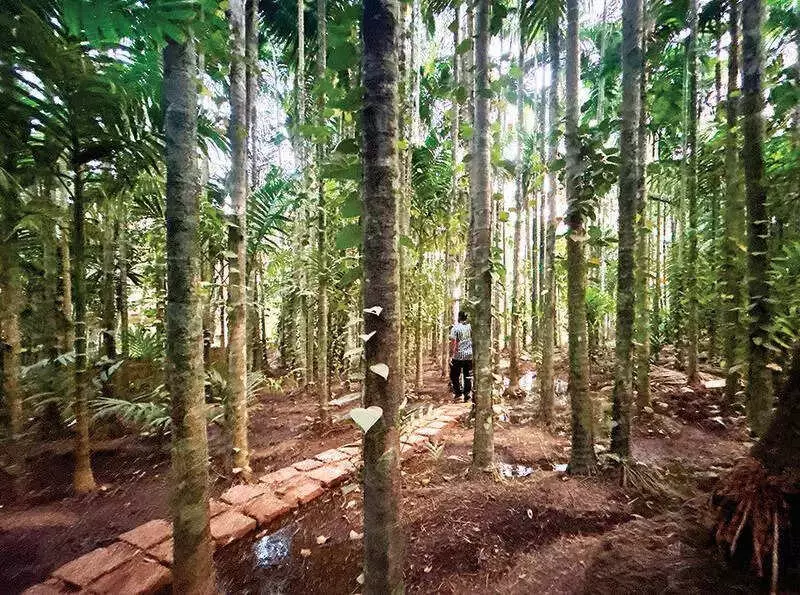
In the serene village of Arambol, nestled at the base of the lush Bhatwadi hills, a government decision has sparked a fierce battle for survival. A recent notification to convert 3 lakh square meters of private forest land into a settlement zone has thrown the future of around 1,000 residents into uncertainty, threatening the very ecosystem that has sustained their families for generations.
The Heart of the Village: Kulaghars and Wells
The lifeblood of this community is its intricate network of horticultural fields, known locally as kulaghars. Each small house is attached to its own kulaghar, nourished by a family well. For people like 54-year-old Ranganath Naik, this system represents more than just agriculture; it is a legacy of self-sufficiency. When his father passed away during his teenage years, the family well was the sole inheritance. "The Bhatwadi hills are our water reservoirs," Ranganath explains, pointing to his rectangular well. "The water that keeps our wells from drying, even in peak summer, springs from these hills. If the trees are cut, our wells and kulaghars will dry up." His mother sustained the family by working their kulaghar after his father's death, a testament to the system's resilience.
A Sacred Grove and Broken Promises
The threat extends beyond water and agriculture. The hill also houses a sacred grove revered by the local community, which now falls within the newly designated settlement area following the land's sale to an outside party. Feeling abandoned by the state's administration, the villagers, supported by nearby Mandrem, have launched sustained protests. Sitaram Naik recounts their frustrating attempts to seek justice: "On September 14, we complained to the forest department about trees being cut. An inspection on September 22 concluded the owner was only clearing bushes. When we stopped a drone conducting a land survey, police warned us for trespassing on land our ancestors frequented for medicinal plants." A retired teacher, Atmaji Naik, echoes the community's ethos: "For generations, we only plucked and never cut. It's in our blood to see these hills as an inheritance to protect, not destroy."

Fear of a Parched Future and Unheeded Appeals
The villagers' fears are concrete. They dread their fate mirroring nearby areas like Morjim, which has become dependent on water tankers. Rohit Satelkar, a local youth, voices a common anger: "Even the rain pattern may be affected. The government has destroyed Goa's land; now they are coming for the hills. This new colonisation by parties from Delhi is worse than the Portuguese, who at least planted cashew trees to conserve soil." Despite assurances from the chief minister and the local MLA, the conversion order stands. A young protester, Shivam Kambli, warns of irreversible damage: "They will destroy an ecosystem that took millennia to develop. Generations of us will be finished before any afforestation can revive it."
For Ranganath Naik, the fight is deeply personal. His dream is simple: to pass on the self-sustained kulaghar, built by his parents' sweat and blood, to his children. "All we have to do is preserve it, and our children will never go hungry," he says with determination. "We cannot fail in this one job we have." As the protests continue, the people of Varchawada stand as guardians of a vanishing way of life, challenging development that imperils their past, present, and future.