

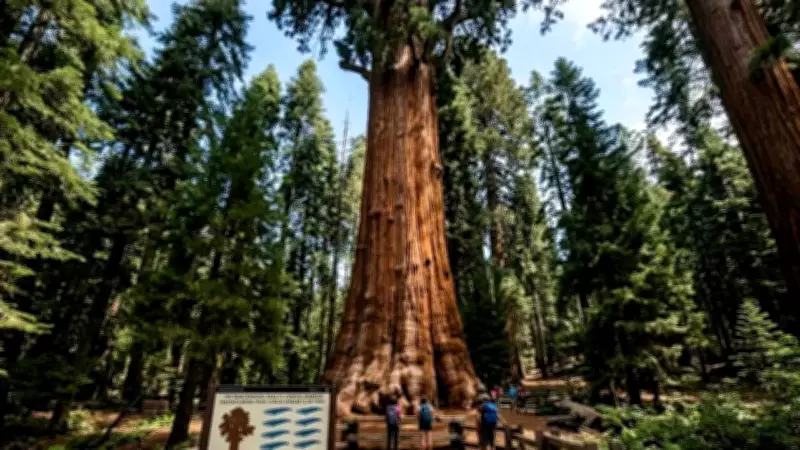
Giant Sequoias: Nature's Living Skyscrapers Defying Biology in California
Experiencing a Giant Sequoia transcends a mere encounter with nature; it immerses you in a realm of sheer impossibility. Nestled within the majestic Sierra Nevada Mountains of California, a vast forest of these ancient giants challenges our fundamental understanding of biology and the scale of living organisms. These trees stand as tall and wide as urban skyscrapers, having personally witnessed the entirety of human history and basked in countless sunrises over millennia. This forest is not just a collection of trees but a sacred sanctuary, where time is measured by the rings in each trunk and weight scales into millions of pounds. A visit to Sequoia National Park reveals these heavyweight champions, prompting profound reflections on their immense size and enduring presence.
How the General Sherman Tree Outweighs More Than 10 Blue Whales
The sheer scale of Giant Sequoias, particularly the iconic General Sherman tree, showcases extraordinary biological characteristics that surpass typical terrestrial species. According to research from the National Park Service, the General Sherman tree is estimated to weigh approximately 1,385 tons based on its trunk volume alone, which measures 52,500 cubic feet. When including the weight of its roots and branches, the total mass escalates to around 2,100 tons. In comparison, adult blue whales average between 150 and 190 tons each, meaning a single Sequoia tree can account for the combined mass of 10 to 14 of these ocean giants, highlighting its monumental stature in the natural world.
Why Sequoias Never Stop Growing: The Chemistry of a 3,000-Year Carbon Sink
While many tree species reach a maximum size dictated by biological processes, Giant Sequoias defy this norm by continuously producing new wood throughout their entire lives. This ongoing growth allows them to act as powerful carbon sinks, adding daily to their mass even after reaching maturity. The secret behind their ability to accumulate biomass for up to 3,000 years lies in their unique chemical makeup. Their bark contains high levels of tannins, which provide robust protection against insect attacks and reduce risks from fire and decay due to humidity. This chemical defense enables Sequoias to sustain an efficient biomass supply over millennia, unlike most trees with shorter life cycles and limited biomass production.

How Shallow Roots Support 1,500 Tons of Living Weight
Despite weighing millions of pounds, Giant Sequoias maintain remarkable stability through a shallow yet extensive root system. Geological and botanical surveys from the National Park Service reveal that these trees lack a deep taproot; instead, their roots typically penetrate no more than 6 to 12 feet into the ground. To support the immense weight of these living "skyscrapers," the roots extend outward between 100 and 150 feet, often interconnecting with those of adjacent trees. This underground network forms a communal mat of wood and soil, creating essential tension that prevents these 1,500-ton giants from toppling over, showcasing a brilliant adaptation to their environment.
Sequoias' Role in Water Cycles and Forest Cooling
These colossal trees are not merely statistical anomalies but play a crucial role in the Sierra Nevada ecosystem. Research conducted by the US Geological Survey (USGS) indicates that the high biomass density of Sequoia trees significantly influences local water cycles and forest cooling. A single mature tree can evaporate several hundred gallons of water daily, facilitated by the enormous surface area of its leaves and the hydraulic pressure generated by its massive trunk. This process helps regulate the localized climate, demonstrating how their mind-bending size contributes to maintaining biodiversity across the entire mountain range, underscoring their ecological importance beyond their awe-inspiring dimensions.






