

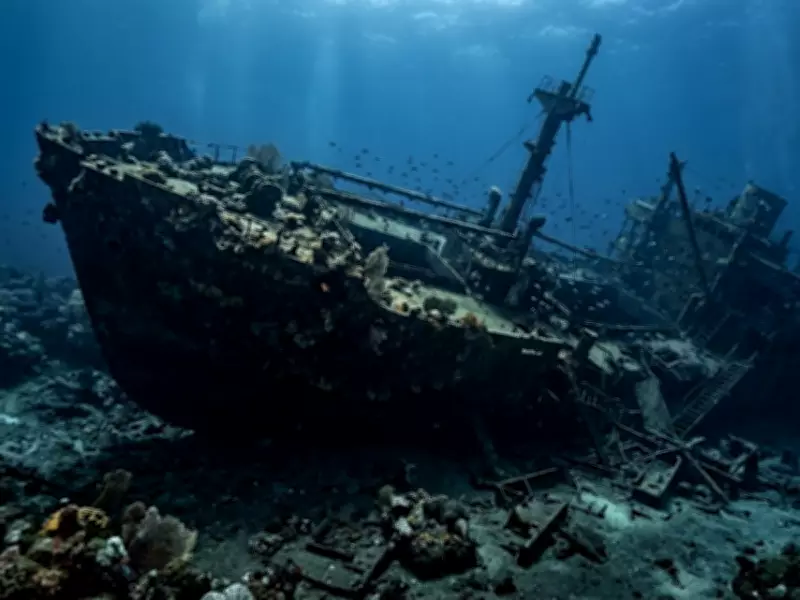
A typical weekend fishing trip often ends with tales of the one that got away, but for Tim Wollak and his six-year-old daughter, Henley, their outing near Green Island on Lake Michigan yielded something far more significant: a piece of American history lost for over a century. What Henley initially mistook for the legendary Green Bay Octopus on their sonar screen turned out to be a shipwreck from the pre-Civil War era, linked to one of the most devastating yet largely overlooked climate-related catastrophes in American history.
Historical Confirmation
The Wisconsin Historical Society has confirmed that the wooden hull, measuring 122 feet and resting in less than 10 inches of water, belongs to the George L. Newman, a barkentine that was destroyed on October 8, 1871. This date coincides with a catastrophic event that swept across the entire region, leaving a trail of destruction.
A Fiery Night
To understand why the George L. Newman ended up at the bottom of Lake Michigan, one must examine the environmental conditions of 1871. On that fateful October night, the ship was carrying a large load of timber across Green Bay when the crew encountered not fog, but thick black smoke. This was the result of the Peshtigo Fire, a massive firestorm that raged on the same day as the Great Chicago Fire. While popular culture remembers the Chicago fire and the legend of Mrs. O'Leary's cow, the Peshtigo Fire was far more destructive, ravaging 1.2 million acres and killing over 1,200 people, making it the deadliest wildfire in United States history.

According to the Wisconsin State Climatology Office, a powerful low-pressure system transformed a series of smaller brush fires into a self-sustaining fire tornado. The atmosphere became so filled with toxic smoke and ash that the crew of the Newman could not see. As they sailed blindly through the night, the ship ran aground on the rocks near Green Island. The lighthouse keeper, Samuel Drew, kept the lamps lit throughout the day to cut through the haze. He quickly rescued the crew, who took shelter in the lighthouse for an extended period, watching as their boat was battered by autumn storms and winter ice before eventually sinking.
Uncovered by Changing Conditions
The George L. Newman lay hidden beneath thick layers of sand for over a century. Its recent emergence is due to changing conditions in the Great Lakes. Extreme weather, fluctuating water levels, and shifting currents are acting like a giant broom, sweeping away sediment and revealing long-lost artifacts. This phenomenon is making historical treasures more accessible, as evidenced by a six-year-old girl spotting a pre-Civil War vessel during a fishing trip.
Maritime experts note that the Newman is one of 13 shipwrecks discovered in the area, almost all found by chance by everyday citizens. Because it lies in shallow water, it offers a rare, tangible glimpse into 19th-century American shipping and the early logging industry that shaped the Midwest.
Preserving the Discovery
With the sand gone, an archaeological team is preparing for spring dives to map the site. Divers will use high-resolution underwater imagery to document every inch of the wooden structure before nominating it for inclusion in the National Register of Historic Places. Since the site is near popular fishing and swimming spots, local authorities urge the public to treat the wreck with care, as it is a fragile piece of shared history preserved in the cold freshwater of Lake Michigan.
For Henley, her father says she initially thought the sonar image would lead to a treasure chest of gold or pirate loot. Instead, she discovered something even more exciting: a direct link to a forgotten historical tragedy, proving that the most fascinating secrets often lie just beneath the surface of our favorite weekend destinations.






