

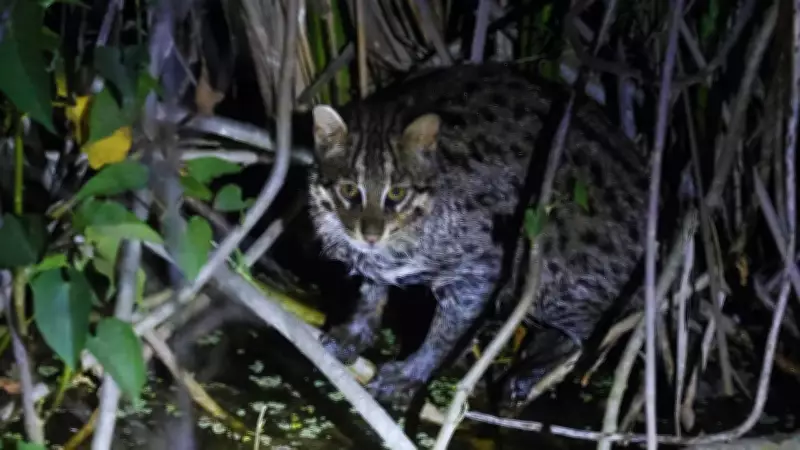
Evening Safari Yields Extraordinary Wildlife Discovery in Uttarakhand
What began as an ordinary journey back from an evening safari has transformed into one of the rarest wildlife records in recent memory, bringing unprecedented attention to the wetlands of Jhilmil Jheel Conservation Reserve within Rajaji National Park. While the reserve is known as home to elephants, tigers, and swamp deer, a sighting of an entirely different predator has captured the imagination of conservationists and wildlife enthusiasts nationwide.
"We Initially Thought It Was a Jungle Cat"
According to Arun Kamath, an experienced birder who made the remarkable discovery while accompanying his son Ashray on their visit to the national park, the encounter occurred under challenging light conditions. "On the evening of April 3, 2026, between 7:45 and 8:00 PM, while returning from our safari to our accommodation, we were traveling on a small road near our night stay," Kamath exclusively shared with Times Travel. "On one side of that road, we observed a cat-like animal seated near the road, while the other side featured a swamp area."
Initially, nothing appeared unusual about the creature. "We thought it was a jungle cat, so we stopped to observe it," Kamath explained. Mistaken identity is common under poor lighting, particularly in regions where multiple small wild cat species coexist. However, what happened next would completely alter their initial assessment and create wildlife history.

The Moment That Changed Everything
"Suddenly, the cat jumped into the water, crossed a small channel, and swam to sit on a bed of reeds," Kamath recounted. This behavior provided the first indication that this was no ordinary jungle cat. While jungle cats may approach water sources, they typically avoid boldly leaping into water and swimming across channels—behavior characteristic of a different, more aquatic species.
Recognizing the significance of what they were witnessing, Kamath and his son illuminated the animal with a torchlight. "This is when we clearly saw the spots and stripes," he added, noting that these markings are completely absent in the monochromatic coats of jungle cats. The distinctive pattern revealed the animal's true identity.
Confirmed as Rare Fishing Cat
The images were subsequently shared with wildlife experts for formal identification, confirming what Kamath had suspected: the animal was a Fishing Cat (Prionailurus viverrinus), a rare and semi-aquatic wild cat species whose specialized habitat includes wetlands and whose unique adaptation involves fishing skills in aquatic environments.
This sighting carries extraordinary significance for multiple reasons. Beyond the inherent rarity of the Fishing Cat itself, the location of the photograph represents a major zoological discovery. In India, Fishing Cats have been studied more extensively in their eastern habitats, particularly in West Bengal's wetland areas including the Sundarbans. Occasional sightings have occurred in Odisha, Andhra Pradesh, and even rare reports from central India including Ranthambore National Park.
Breaking New Geographical Ground
The Jhilmil Jheel Conservation Reserve had never before documented this species within its boundaries. "There are no records of fishing cats from this region," Kamath emphasized, highlighting the groundbreaking nature of their observation.
While there have been limited hints about the species' presence in the broader region—including a camera trap record from Corbett in 2022–23 and one rescue record from Nainital—such evidence remains sparse and doesn't necessarily indicate an established population. "But people actually seeing it and photographing it in the wild, this is probably the first time in this area," Kamath stated, underscoring the uniqueness of their visual documentation.
Perfect Habitat, Unexpected Resident
Jhilmil Conservation Reserve presents an ecosystem that appears ideally suited for Fishing Cats, with its extensive swamps, grasslands, and wetland systems creating habitat conditions that should theoretically support the species. The presence of barasingha (swamp deer) populations further suggests robust wetland-based wildlife in the area. Yet despite these favorable environmental factors, this particular predator had remained unrecorded until now.

This observation raises intriguing ecological questions. Several possibilities exist: Fishing Cats may have inhabited the area all along but remained undetected due to their elusive, nocturnal behavior; this could represent range extension resulting from changing ecological conditions and dispersal needs; or the observed individual might be a transient animal seeking new territory.
Conservation Implications for a Vulnerable Species
Regardless of the explanation, the discovery carries substantial conservation importance. The International Union for Conservation of Nature (IUCN) currently classifies Fishing Cats as Vulnerable, indicating high risk of extinction in the wild. The species faces mounting threats from wetland degradation, habitat fragmentation, and increasing human-wildlife conflict across its range.
With wetlands throughout India experiencing significant pressure from development and climate change, every new record of a wetland-dependent predator like the Fishing Cat becomes critically important for conservation planning and habitat protection strategies. This sighting not only expands the known range of this vulnerable species but also highlights the ecological value of Jhilmil Jheel Conservation Reserve as potential habitat for specialized wetland predators.
The photographic evidence from Kamath's encounter provides tangible documentation that could influence future research priorities and conservation initiatives in Uttarakhand's protected areas, potentially leading to increased monitoring efforts and habitat protection measures for this rarely-seen aquatic feline.





