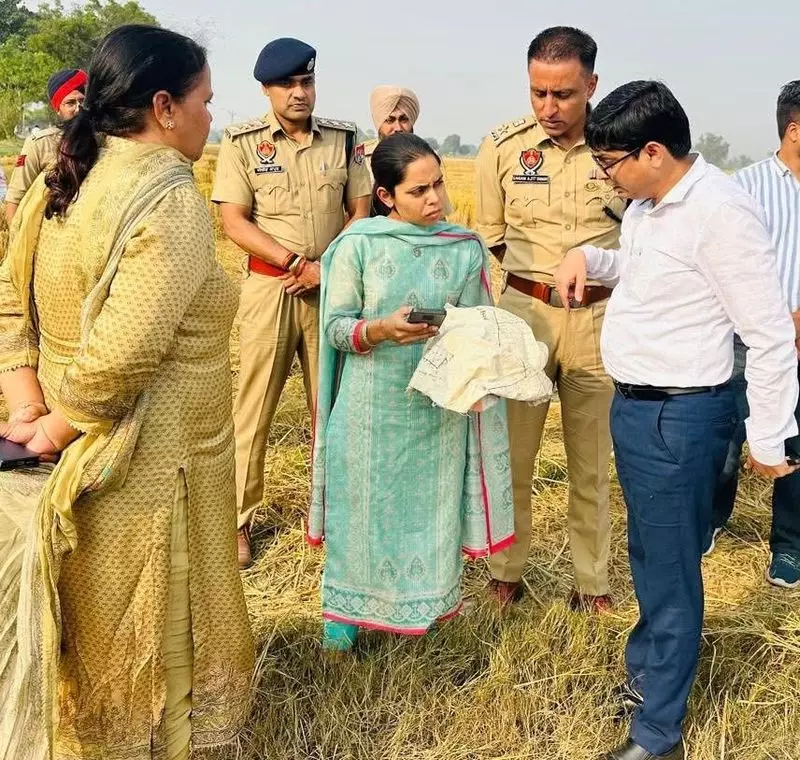
Agricultural authorities in Malerkotla district are encountering significant resistance from local farmers as they intensify their campaign against stubble burning during the current paddy harvesting season. The enforcement drive, aimed at reducing air pollution, has sparked confrontations between farming communities and government officials.
Direct Confrontations in the Fields
Teams comprising officials from the agriculture and revenue departments have been conducting extensive field inspections across the district. During their monitoring activities on Tuesday, they faced direct opposition from farmers who defended their practice of burning paddy straw. The situation escalated as agriculturalists voiced their frustrations about the lack of viable alternatives for managing crop residue.
One revenue official, speaking on condition of anonymity, revealed the challenging circumstances they encounter daily. "Farmers are becoming increasingly assertive when we attempt to document stubble burning incidents," the official stated. "They question why they should bear additional expenses for machinery like happy seeders or straw management systems when burning provides a cost-free solution."

The Enforcement Mechanism and Its Challenges
The administration employs a multi-layered approach to identify and penalize violators. Approximately 40 teams have been deployed throughout the district, utilizing both ground patrols and technological surveillance. These teams coordinate with field staff who monitor specific areas, while the government also employs satellite imagery to detect active farm fires from space.
Despite these comprehensive measures, enforcement remains problematic. When officials attempt to reach burning sites, they frequently meet with obstruction from local communities. In many instances, farmers and their supporters prevent authorities from approaching the fields, creating significant barriers to effective enforcement of environmental regulations.
The Farmer's Perspective and Economic Realities
From the agricultural community's viewpoint, the issue revolves around economic practicality rather than environmental disregard. Farmers argue that managing paddy straw through approved methods imposes substantial financial burdens that many small-scale operators cannot shoulder.
The cost of renting happy seeders or super seeders, which range between ₹1,500 and ₹2,000 per acre, represents a significant expense for marginal farmers. Similarly, employing straw balers or cutters adds another ₹2,000 to their production costs. For agriculturalists already grappling with rising input expenses and uncertain market returns, these additional costs prove prohibitive.
One farmer from the affected area explained their dilemma: "We understand the environmental concerns, but we need practical, affordable solutions. Burning remains the only immediately accessible method for clearing fields quickly between paddy harvesting and wheat sowing seasons."
Administrative Resolve and Environmental Imperatives
Despite the resistance, district authorities maintain their commitment to reducing stubble burning. Officials emphasize that continuing the enforcement drive remains crucial for protecting air quality across northern India, particularly as winter approaches and meteorological conditions become conducive to pollution accumulation.
The administration continues to promote awareness about available subsidies for agricultural machinery and alternative management techniques. However, the implementation gap between policy intentions and ground realities persists, creating ongoing tensions between environmental protection efforts and agricultural livelihoods.
As the paddy harvesting season progresses, the standoff in Malerkotla reflects broader challenges in balancing ecological responsibility with economic viability in India's agricultural heartland.