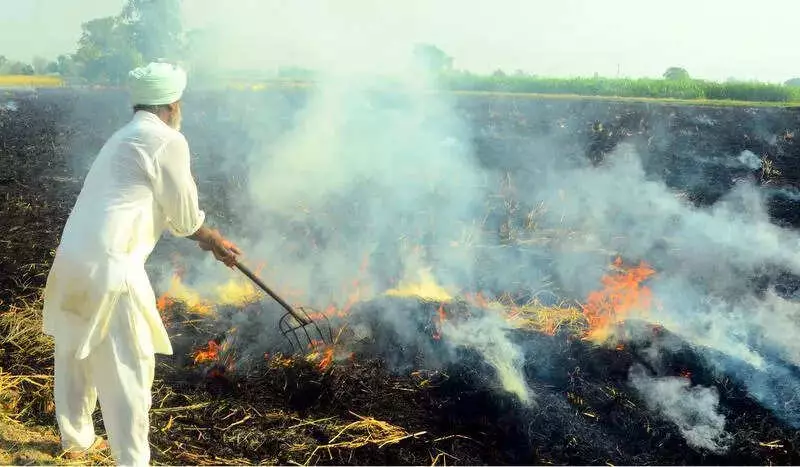
A significant shift in the sources of Delhi's toxic winter air has been revealed by a new study. The contribution of stubble burning from neighbouring states to the capital's pollution plummeted to an average of just 7% in November 2025, a sharp decline from 20% recorded in November 2024. The findings were published in a monthly air quality snapshot released on Saturday by the independent research organisation, the Centre for Research on Energy and Clean Air (CREA).
Dramatic Decline in Farm Fire Impact
The report provides a detailed breakdown of the reduced influence of agricultural residue burning. The peak daily contribution of stubble burning to Delhi's PM2.5 reached 22% this November, which is significantly lower than the 38% peak observed in the same month last year. On 20 days in November 2025, the contribution ranged from 0% to 10%, a stark contrast to just two such days in November 2024.
Furthermore, there was not a single day in November 2025 where farm fires contributed to more than 30% of Delhi's fine particulate pollution. Last year, there were four such severe days. This decline aligns with an 80%-90% drop in farm fire cases reported over the past four years in Punjab and Haryana, states historically blamed for triggering the National Capital Region's (NCR) air pollution crisis.

Persistent Pollution Points to Year-Round Sources
Despite this positive trend, air quality across the NCR deteriorated. The CREA report notes a paradoxical situation: 20 out of 29 cities in the NCR recorded higher pollution levels in November 2025 compared to the previous year. Many of these cities failed to register even one day within the safe National Ambient Air Quality Standards (NAAQS) of 40 µg/m³ for PM2.5.
This indicates, according to CREA analysts, that the dominant drivers of pollution are now persistent, year-round sources. Transport emissions, industrial activity, power plants, and other combustion sources are playing a larger relative role as the seasonal spike from farm fires diminishes.
Haryana Towns Among Nation's Most Polluted
The report sheds light on severe pollution within the NCR itself, particularly in Haryana. Three Haryana towns—Bahadurgarh, Sonipat, and Rohtak—remained among the ten most polluted cities in the entire country. Sonipat experienced 'very poor' air quality (PM2.5 between 121-250 µg/m³) on 29 out of 30 days in November.
Bahadurgarh was the second most polluted city nationally with an alarming average PM2.5 concentration of 215 µg/m³. In Punjab, Mandi Gobindgarh was the most polluted with a level of 93 µg/m³. Shockingly, all 22 monitored cities in Haryana exceeded the daily PM2.5 standard every single day of the month, as did seven cities in Punjab.
The data presents a clear message: while efforts to curb stubble burning are showing results, the battle for clean air in northern India requires a relentless focus on tackling the perennial pollution from urban and industrial sources.