El Mencho Killed in Security Operation: End of a Drug Lord's Reign
Nemesio Oseguera Cervantes, the notorious drug lord widely known as El Mencho, has died following a major security operation aimed at his arrest in Mexico's Jalisco state. According to the defence ministry, he sustained serious injuries during intense clashes between the army and members of the Jalisco New Generation Cartel (CJNG) and later succumbed to his wounds while being transported to Mexico City for medical treatment.
Operation Details and Aftermath
The confrontation resulted in significant casualties and seizures:
- Four cartel members were killed in the municipality of Tapalpa.
- Three soldiers sustained injuries during the operation.
- Security forces confiscated multiple vehicles and heavy weapons from the cartel.
In response to the operation that led to Oseguera's death, violence erupted in several Mexican states, a pattern previously observed during attempts to capture high-ranking cartel figures. The United States had offered a $15 million reward for information leading to his capture and confirmed providing intelligence support to Mexican authorities.

From Police Officer to Drug Kingpin
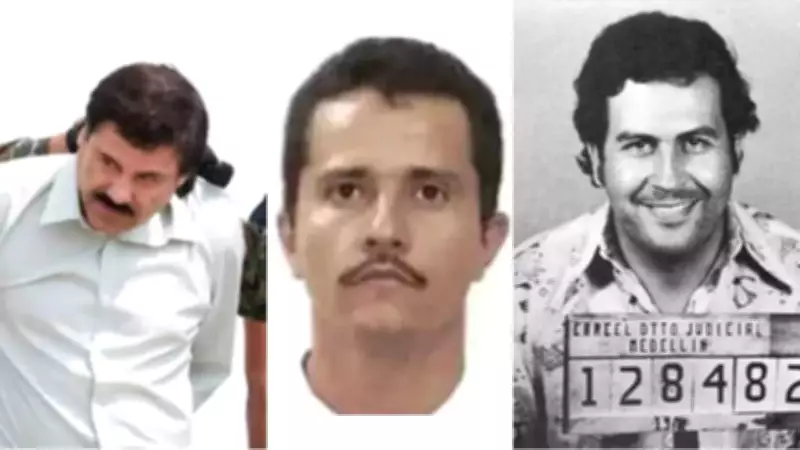
Nemesio Oseguera Cervantes rose from being a former police officer to become the head of the CJNG, building a major drug empire that authorities compared to those of Joaquín "El Chapo" Guzmán and Pablo Escobar. Over the past decade, the CJNG expanded rapidly across Mexico and into international drug markets, with Mexican and U.S. authorities accusing the organization of trafficking substantial quantities of cocaine, methamphetamine, and fentanyl.
The cartel became notorious for its open confrontations with security forces, employing tactics such as roadblocks, burning vehicles, and coordinated attacks. Despite being listed among the U.S. government's most wanted fugitives and facing sanctions on businesses linked to his cartel, Oseguera managed to evade arrest for years until this decisive operation.
Historical Context: The Legacy of Drug Lords
Before El Mencho's rise, the name most associated with Mexican drug trafficking was Joaquín "El Chapo" Guzmán, who transformed the Sinaloa Cartel into a global network from the late twentieth century onward. Guzmán's career was marked by dramatic prison escapes in 2001 and 2015 before his final capture in 2016 and subsequent life imprisonment in the United States in 2019.
Years earlier in Colombia, Pablo Escobar had already established the model for modern drug empires as leader of the Medellín Cartel during the 1980s and early 1990s. Escobar controlled international cocaine supply chains and used extreme violence, including bombings and assassinations, before being shot dead by Colombian security forces in 1993.
The Continuing Challenge of Organized Crime
The deaths or imprisonment of high-profile figures like El Mencho, El Chapo, and Pablo Escobar have not eliminated drug trafficking. Instead, organizations have splintered, reformed, and shifted routes in response to enforcement efforts. The rise of synthetic drugs such as fentanyl has altered trafficking economics, reducing reliance on traditional coca cultivation while maintaining Mexico as a central corridor for drugs entering the United States.
From El Mencho to El Chapo and Pablo Escobar, each figure represented a different stage in the evolution of organized crime. Their names became shorthand for wider systems built on smuggling, corruption, and violence. While removing one leader delivers a significant blow, it rarely dismantles the underlying criminal structures, as others inevitably step forward to fill the void.