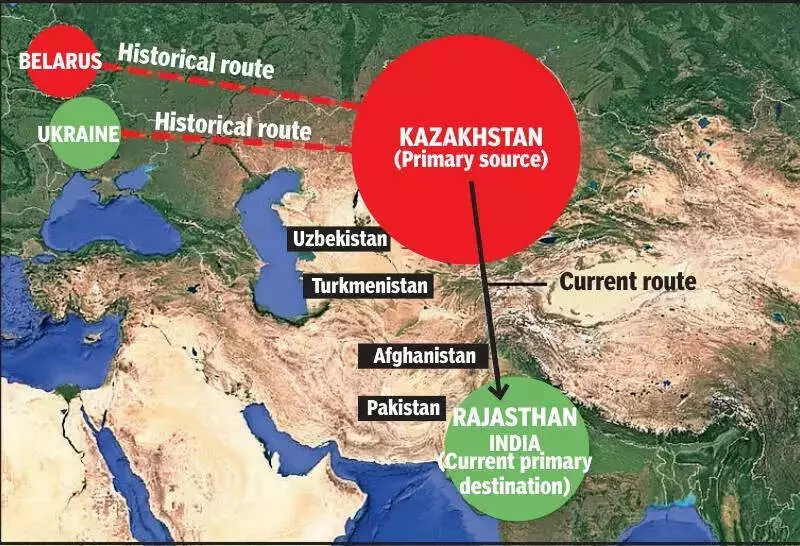
The ripple effects of human conflict are now visibly altering the natural world, reaching high into the skies above Eurasia. The war in Ukraine, having reshaped global politics, is compelling a dramatic shift in the ancient migratory patterns of large birds of prey. Since 2022, disruptions along the vital Black Sea and eastern European air corridors have forced several raptor species, including the globally endangered Egyptian vulture, to abandon their traditional routes and seek new paths to survival.
A Sanctuary Forged in Sand
New research from the Central Asian Vultures Project (2022–2025) has identified a clear winner in this unexpected ecological shift: the Indian state of Rajasthan. The study confirms that Rajasthan is now the single most important wintering ground for Egyptian vultures (Neophron percnopterus) across their entire migratory range. Satellite tracking data paints a stark picture of change. To avoid the war-torn regions of Ukraine and its surrounding airspace, many vultures are now bypassing the Black Sea basin entirely.
Their new journey takes them on an eastern detour over the Caspian Sea. From their breeding grounds, they traverse through Kazakhstan, Turkmenistan, Uzbekistan, Iran, Afghanistan, and Pakistan before finally arriving in western India. "Tagged vultures are now arriving in India more frequently than in Central Asia or Arab countries," said Dau Lal Bohra, an ornithologist specializing in raptor conservation. "Estimates suggest that India offers better foraging opportunities and suitable habitats. In comparison, vultures now prefer India over Pakistan."

Mapping the New Central Asian Flyway
The four-year study meticulously tracked 19 birds tagged in Uzbekistan, Kazakhstan, and Kyrgyzstan. Their movements were mapped along the challenging Central Asian Flyway, a major avian highway connecting Eurasia to South Asia. Fourteen of these vultures completed twenty-three full migrations, covering an average of 2,663 kilometres annually. One remarkable bird, named Timur, set a record with a journey of 6,873 kilometres.
Dr. Vladimir Dobrev, Egyptian Vulture Conservation Officer, explained the consistent pattern: "The tracked vultures began in the Kyzylkum Desert, the Karatau Mountains, and the Shahrisabz region. They then followed a southward trajectory, crossing Afghanistan via the Kabul River Valley, over the Hindu Kush Mountains, into Pakistan, and finally to wintering sites in India." The data shows that nearly all these migrants settled in the districts of Bikaner, Jodhpur, and Jaisalmer in Rajasthan, often staying for several months through the winter.
Bikaner: The Unlikely Global Hub
Among the wintering zones, Bikaner emerged as the largest and most consistent congregation site, attracting multiple birds every season. Jodhpur and Jaisalmer also saw repeated arrivals, with juvenile vultures often roosting on towers near wind farms and power lines. While some activity was recorded around Karachi and Islamabad in Pakistan, these remained secondary zones.
The transformation of Bikaner's Jorbeer Conservation Reserve is particularly notable. Once a municipal carcass dump, it is now internationally recognized as a critical wintering site for scavengers. "Bikaner has become a global hub for these long-distance migrants," remarked a project researcher. "Every winter, the sky over Jorbeer turns white with wings. It's an ecological spectacle that connects Central Asia with Rajasthan's deserts." The reserve supports not just Egyptian vultures but also steppe eagles and cinereous vultures.
This research provides concrete evidence of how geopolitical instability directly impacts biodiversity. Following earlier findings that the Ukraine war altered routes for greater spotted eagles, scientists now have confirmation that Egyptian vultures are making similar difficult choices, skipping crucial stopover sites for the safety of Rajasthan's sands. This unexpected sanctuary offers a glimmer of resilience for these endangered birds amidst human conflict.