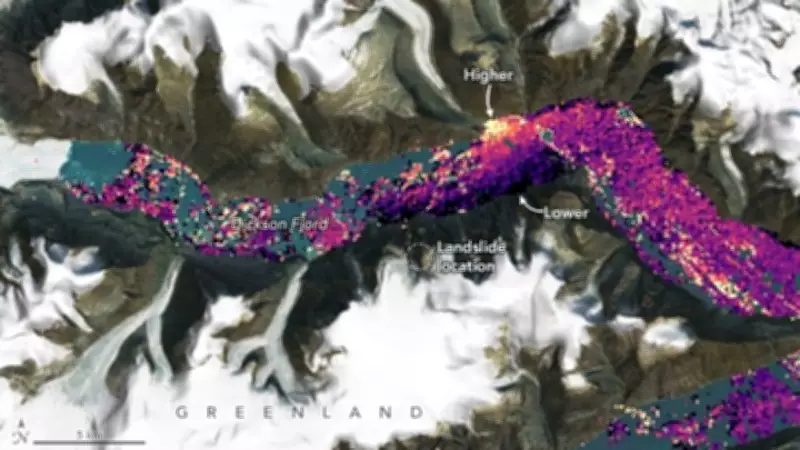
Earth's 9-Day Seismic Bell Ring Traced to Greenland Megatsunami
In a remarkable scientific discovery, researchers have determined that Earth literally "rang like a bell" for an unprecedented nine days in September 2023. This eerie seismic signal, detected globally, has now been traced back to a catastrophic megatsunami in Greenland's Dickson Fjord, triggered by a colossal rockslide. The event highlights the profound and often unexpected consequences of climate change in the rapidly warming Arctic region.
The Trigger: A Climate Change-Driven Landslide
According to a groundbreaking study published in the journal Nature Communications, the seismic hum originated from a 25.5 million cubic metre rockslide that plunged into the 540-metre-deep Dickson Fjord. This massive landslide was directly linked to glacial melting caused by rising temperatures, which destabilized the surrounding slopes. The impact generated an initial tsunami wave reaching an astonishing 200 metres in height, setting off a chain reaction of prolonged water oscillations within the fjord.
Unveiling the "Fjord Resonance" Phenomenon
Satellite imagery from Copernicus Sentinel-2 and NASA's Surface Water Ocean Topography (SWOT) mission played a crucial role in confirming the source. The data revealed a distinct 90-second seiche—a standing wave pattern—that matched the global seismic signals. The narrow, cliff-lined geometry of Dickson Fjord, with walls soaring over 3,000 feet, amplified this effect, creating a resonant sloshing akin to water in a giant bathtub. This persistent oscillation transferred energy directly into Earth's crust, causing the planet-wide vibrations.

Location and Historical Context of Dickson Fjord
Dickson Fjord is situated in the northernmost part of the King Oscar Fjord system, serving as the largest branch of Kempe Fjord in Greenland. It was first surveyed in 1899 by Swedish Arctic explorer Alfred Gabriel Nathorst during the Swedish Greenland Expedition and named after financier Robert Dickson. Historically, the fjord has been a site of scientific interest, with depth measurements recorded as early as 1930. Its remote location, however, has not shielded it from the impacts of modern climate change.
Scientific Insights into the Crustal Heartbeat
Seismic stations worldwide captured the event as smooth, rhythmic peaks occurring precisely every 90 seconds, with minimal decay over nearly two weeks. This pattern was unlike typical earthquake readings, which are usually erratic. Researchers noted that no previous seiche had ever produced such enduring global signals. Modeling efforts estimated the sloshing waves at between 2.6 and 9 metres, with discrepancies arising from assumptions about the fjord's complex geometry. "Simulating this prolonged, sloshing tsunami proved a major challenge," remarked Alice Gabriel of UC San Diego’s Scripps Institution of Oceanography, underscoring the novelty of the phenomenon.
Climate Change and Growing Risks in the Arctic
The instability leading to the rockslide is a direct result of warming air and sea temperatures, which have eroded the glacial ice that once stabilized the slopes. "Climate change alters Earth's norms, unleashing atypical events," observed Gabriel. This incident echoes a similar tragedy in Karrat Fjord in 2017, where a landslide-generated tsunami destroyed homes and claimed lives. With Dickson Fjord located near a key Arctic cruise path and tourism on the rise, the risks are escalating. Authorities are now exploring early-warning systems that integrate satellite and seismic data to mitigate future threats.
Implications for Global Monitoring and Safety
The discovery underscores the urgent need for enhanced monitoring of remote Arctic regions, where climate-induced landslides pose significant hazards. The ability of such events to generate planet-wide seismic signals offers a new tool for scientists to detect and study similar occurrences elsewhere. As the Arctic continues to warm at an accelerated rate, understanding these dynamics is critical for protecting communities and infrastructure from unforeseen natural disasters.