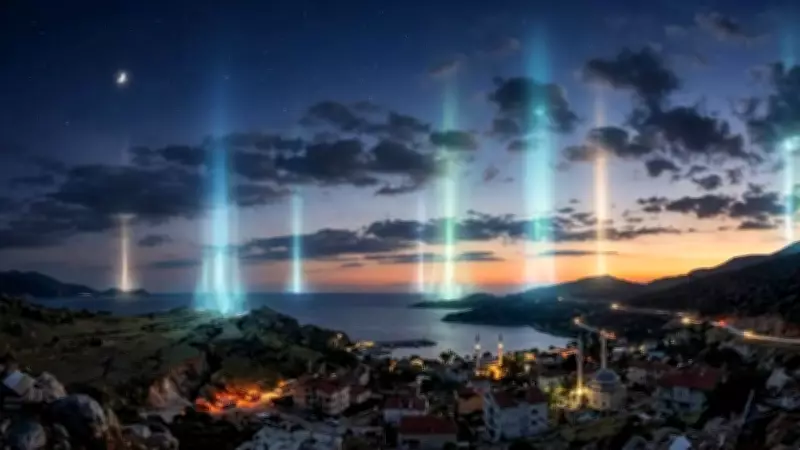
Earthquake Lights: From Turkish Folklore to Scientific Reality Post-2026 Quake
In the aftermath of the devastating April 2026 earthquake in Turkey, the world has been mesmerized by reports of mysterious floating lights appearing in the sky. These luminous displays, deeply rooted in local folklore, are now being recognized by scientists as genuine atmospheric phenomena known as 'earthquake lights' or EQL. This remarkable convergence of ancient cultural beliefs and cutting-edge geophysical research offers a fascinating glimpse into how the Earth's internal forces can manifest in visible ways.
The Science Behind Earthquake Lights
For decades, reports of luminous spheres, vertical beams, and glowing atmospheric displays around seismic events were often dismissed as optical illusions or unidentified flying objects. However, the scientific community has undergone a significant shift in understanding. The United States Geological Survey (USGS) now formally recognizes EQL as rare but real co-seismic or pre-seismic luminous events that occur primarily at rift zones where tectonic stress is most concentrated.
According to USGS documentation, earthquake lights can manifest in various forms including sheet lightning, balls of light, streamers, and steady glows that may appear for extended periods before, during, or after significant earth movements. These phenomena are among the few types of optical events observable in the presence of extreme tectonic stresses, making them valuable indicators of geological processes.

How Tectonic Pressure Creates Atmospheric Glows
Research presented through the European Geosciences Union (EGU) provides compelling explanations for how earthquake lights form. In regions like Turkey, where intense lithospheric stress affects crustal materials such as igneous rocks, this pressure activates what scientists call 'p-holes' or positive charge carriers.
When subjected to enormous stress, these p-holes are released from deep within the Earth's crust. As they travel toward the surface and interact with the atmosphere, they create an ionized environment that manifests as luminous plasma-like discharges. This process essentially 'charges' the atmosphere through the Earth's internal pressures, producing the silent, glowing phenomena witnessed during seismic events.
Satellite Tracking and Global Monitoring
NASA and other international space agencies have developed sophisticated methods to track these atmospheric changes using satellite sensors. Published scientific papers by the International Union of Radio Science (URSI) describe this process as 'energetic coupling' between the Earth's crust and the atmosphere.
During significant earthquakes, massive transient electric potentials build up in the Earth's crust. These electrical charges can couple with the lower atmosphere and ionosphere, creating the flashes of light documented through global satellite networks and digital observations from earthquake epicenters. This technological monitoring has provided crucial data confirming the reality of earthquake lights as measurable geophysical events.
Why Fault Lines Are Primary Locations
Research published in Seismological Research Letters reveals a striking pattern: approximately 97 percent of documented earthquake light cases occur at or near rift zone environments. These are areas where the Earth's tectonic plates are separating and creating sub-vertical fault systems.
These geological formations essentially function as 'high-speed conduits' for electrical charges generated deep beneath the Earth's surface. During or just before seismic events, these faults facilitate the rapid propagation of electromagnetic pulses to the surface, literally lighting up the sky above areas of intense geological activity.
The transition of earthquake lights from mythological curiosity to legitimate scientific investigation represents a significant advancement in our understanding of Earth's complex systems. As researchers continue to study these phenomena, they bridge the gap between ancient cultural observations and modern scientific discovery, revealing how the planet's internal pressures can create visible atmospheric displays that have captivated human imagination for centuries.