MP Pollution Control Board Report Highlights Critical Air Quality Issues in Bhopal
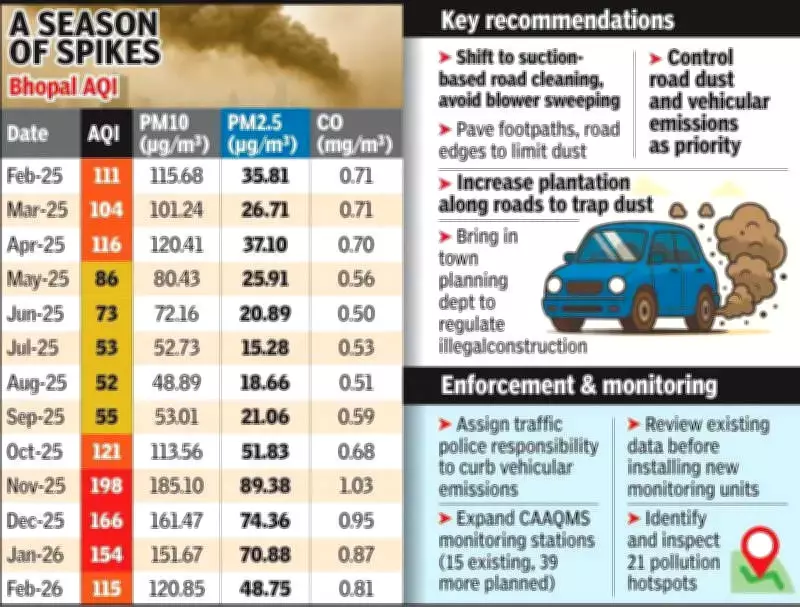
In a significant report presented before the National Green Tribunal (NGT) central bench, the Madhya Pradesh Pollution Control Board (MPPCB) has pinpointed dust pollution and vehicular emissions as major contributors to the deteriorating air quality in Bhopal. The findings are based on a comprehensive study conducted by the Automotive Research Association of India (ARAI), which identified PM 2.5 and PM 10 as the foremost pollutants, with increasing dust and vehicle exhausts as their primary sources.
Similar Concerns in Gwalior and Other Non-Attainment Cities
A parallel study carried out in Gwalior by IIT Kanpur corroborated these results, tracing abnormally high levels of PM 2.5 and PM 10 as key factors behind the worsening air in that city. These studies were commissioned by the MPPCB to assess ambient air quality in 'non-attainment' cities, a classification assigned by the Central Pollution Control Board (CPCB) to urban areas that have consistently failed to meet National Ambient Air Quality Standards (NAAQS) over a five-year period.
The list of non-attainment cities includes Bhopal, Mandideep, Indore, Gwalior, and Jabalpur, all part of the National Clean Air Programme (NCAP) under the Union Ministry of Environment, Forest & Climate Change. This programme sets a target to reduce air pollution by 40% by 2026. The NGT central bench ordered these assessments during a hearing in the Rashid Noor Khan vs State of MP case, with studies for Bhopal and Gwalior completed, and reports for Indore and Jabalpur drafted pending peer review. Assessments for Ujjain, Dewas, and Sagar are still ongoing.

Action Plans and Recommendations for Improvement
Citing the ARAI study for Bhopal, the MPPCB report emphasizes that the action plan based on 'source apportionment' must be executed by stakeholders to improve air quality across all non-attainment cities in Madhya Pradesh. Earlier inspections led to the development of an Emergency Response System Plan, a Graded Response Action Plan (modeled on the National Capital Region), and a specific action plan for these cities.
These plans were presented to a 14-member joint committee established by the NGT to monitor air quality and suggest improvements. After reviewing the ARAI report, the panel recommended urgent measures to control road dust and vehicular emissions. The state urban administration and transport departments have been directed to take necessary actions to cleanse the air in these cities.
Specific Measures Proposed by the Joint Committee
The committee proposed several concrete steps to mitigate pollution:
- Implement a suction process to remove accumulated road dust instead of using machine blowers, with roads cleaned at the outer lanes.
- Ensure end-to-end pave blocking on sidewalks and corners to prevent dust accumulation.
- Undertake suitable plantation of herbs, shrubs, and plants at boat areas and road ends to effectively control dust emissions.
Additionally, the urban administration department recommended involving the town and country planning department to curb illegal construction, which often contributes to dust gathering. The transport department was urged to empower traffic police to enforce measures against vehicular emissions.
Future Steps and Monitoring Initiatives
The MPPCB report notes that representatives from ARAI, Pune, have been invited to a forthcoming meeting for detailed discussions on the Source Apportionment study for Bhopal. It also advises installing more Continuous Ambient Air Quality Monitoring System (CAAQMS) units in Bhopal, with a review of existing data to identify suitable locations. So far, 15 CAAQMS units have been installed in non-attainment cities, and the purchase of 39 more units for Madhya Pradesh is in process.
Members of the joint committee will conduct site visits and inspections of 21 hotspots identified in the SA study for Bhopal to formulate the Graded Response Action Plan and a Long-Term Action Plan. The report concludes that all recommended actions must be implemented on the ground by the concerned departments to achieve meaningful improvements in air quality.