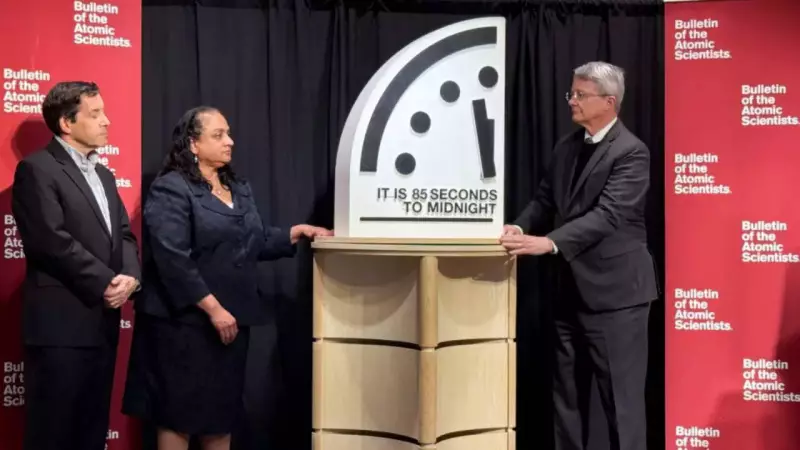
The symbolic Doomsday Clock, maintained by the Bulletin of the Atomic Scientists, now stands at a mere 85 seconds before midnight, marking the closest it has ever been to representing global catastrophe. This adjustment, announced recently, represents a slight but significant shift from last year's setting of 89 seconds to midnight. The clock is updated annually to reflect global conditions rather than predict specific events, serving as a stark warning about humanity's proximity to self-destruction.
Nuclear Dangers and Treaty Challenges Escalate
Alexandra Bell, president of the Bulletin of the Atomic Scientists, emphasized that recent developments offer little reassurance regarding nuclear risks. Several critical arms control agreements remain under severe strain, while others face imminent expiration. Bell specifically referenced Russia's ongoing war in Ukraine, military activities involving the United States and Israel in Iran, and persistent tensions between India and Pakistan. Additionally, issues in East Asia, including the Korean Peninsula and Taiwan, were cited as contributing factors to the heightened global risk assessment.
Bell noted that competition among major world powers has significantly complicated international cooperation. Analysts have echoed these observations in recent years, pointing to reduced diplomatic engagement and limited progress on arms control initiatives. The New START treaty, which caps deployed nuclear warheads, is set to expire in February, adding urgency to the situation. Russian President Vladimir Putin has reportedly suggested a one-year extension, but the United States has not yet publicly responded. In October, former President Donald Trump's order to review nuclear testing procedures drew attention from policy experts, further highlighting the fragile state of nuclear diplomacy.

AI and Climate Change Amplify Global Threats
While nuclear weapons remain a primary concern, the Doomsday Clock's setting also incorporates other critical factors, including artificial intelligence and climate change. Some experts have expressed growing concern about the rapid adoption of AI systems, particularly in areas linked to national security and information sharing. Nobel Peace Prize winner Maria Ressa has spoken extensively about the effects of technology on public discourse and trust, warning that unregulated AI could exacerbate global instability.
Climate change continues to pose a separate but equally pressing threat. Scientists consistently track rising global temperatures and increasing weather extremes, with these developments well-documented in long-term climate data. The intersection of environmental degradation with geopolitical tensions creates a compounding effect on global security, making coordinated international action more challenging than ever.
Global Leadership Crisis Hinders Cooperation
Bell explained that the Doomsday Clock also reflects broader challenges in international coordination. Political tensions and strategic rivalries have made collective action increasingly difficult across multiple regions, including Europe, Asia, and the Americas. Experts suggest that the current global crisis is not the result of a single event but rather the accumulation of numerous unresolved issues that have been allowed to fester over time.
Historical Context and Symbolic Purpose
First created in 1947 to illustrate nuclear risk during the early Cold War, the Doomsday Clock has been adjusted forward and backward over the decades as global conditions have changed. Last year's setting was already alarmingly close to midnight, and this year's smaller shift reflects continuity in deteriorating conditions rather than a sudden change. The Bulletin has consistently stressed that the clock is a symbolic tool intended to prompt serious discussion and encourage proactive measures, not to incite panic.

Researchers involved in the process maintain that progress remains possible through renewed diplomacy, effective regulation, and strengthened international cooperation. They emphasize that the Doomsday Clock serves as a signal—a call to action—rather than an irreversible countdown to doom. By highlighting interconnected risks from nuclear weapons, climate change, and emerging technologies like AI, scientists hope to galvanize global leaders and citizens alike to address these pressing challenges before it's too late.