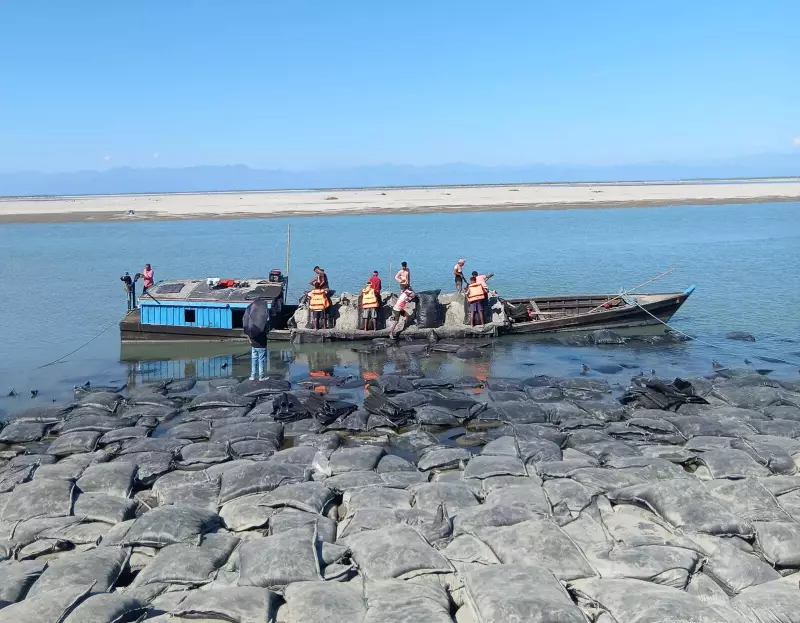
Authorities in Assam's Dibrugarh district have initiated a critical pre-monsoon operation to shield vulnerable riverbanks from the mighty Brahmaputra's erosive force. The district's Water Resources Department (WRD) is deploying a combination of modern and traditional techniques, including US-made geo textile bags and porcupine structures, to fortify the banks.
A Dual-Pronged Defense Strategy
The focus is currently on an 800-metre stretch in areas like Nagaghuli, which has been severely affected by erosion. Here, the geo bags and porcupines are being placed strategically. The geo bags provide rapid, flexible armouring directly on the bank, preventing the underlying soil from being washed away. Simultaneously, the porcupine structures are installed in the water to absorb and dissipate the energy of the river's waves.
Dibrugarh WRD engineer Suman Sonowal explained the sustainable logic behind this dual approach. "The Brahmaputra’s force demands a dual strategy. We use the geo bags for rapid, flexible bank armouring, protecting the immediate soil structure. Concurrently, the porcupines work in the water to dissipate the energy and, crucially, help the river deposit its own sediment," Sonowal said. He emphasized that the goal is to calm the river near the bank, allowing it to heal itself under the protective layer of geo bags.

Round-the-Clock Winter Work for Monsoon Readiness
Officials stated that work is proceeding round-the-clock during the winter season to ensure preparedness before the next monsoon. Similar protective projects are being implemented along extended stretches of the riverbank in Dibrugarh, from Maijan to Mohanaghat.
In addition to the geo bags and porcupines, enhancement of river spurs adjacent to Dibrugarh city is also underway. This project comprises 8 stone spurs, 3 permeable spurs, and 47 wooden spurs, forming a comprehensive defense network against the shifting river.
A Long-Standing Battle Rooted in History
Dibrugarh's intense struggle against river erosion is not new. It traces its origins back to the catastrophic 1950 Assam earthquake, which struck on August 15. That seismic event fundamentally altered the Brahmaputra’s course and raised its riverbed several metres above the city’s ground level, making the area perpetually vulnerable to flooding and bank collapse.
The current measures represent a continued and evolving effort by the Water Resources Department to combat the river's aggressive forces with a mix of imported technology and field-tested traditional methods, aiming for a more sustainable solution to a decades-old problem.