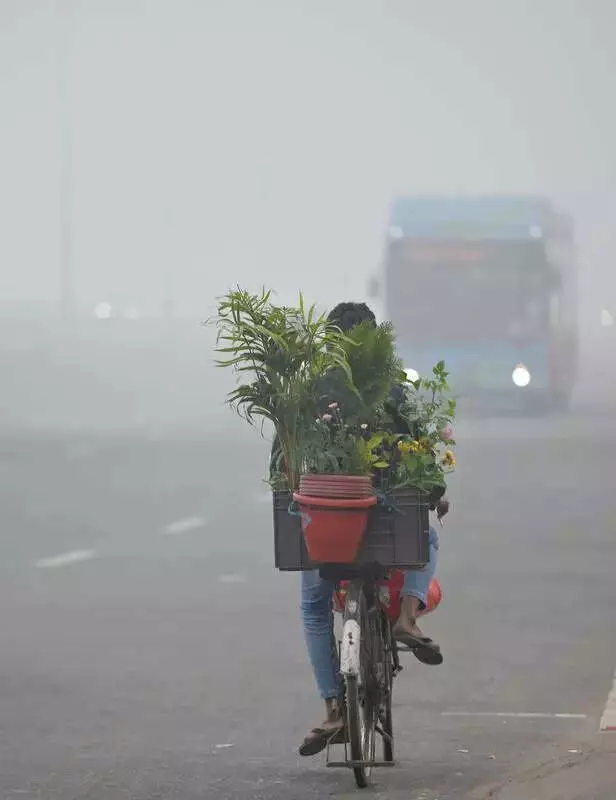
New Delhi witnessed a sharp and worrying decline in its air quality on Tuesday, plunging back into the 'severe' category after a brief respite of seven days. This marks the fourth such severe air day in the current month, raising fresh concerns for residents and authorities alike.
AQI Readings Paint a Grim Picture
The city's Air Quality Index (AQI), measured on a scale from 0 to 500, registered alarming numbers throughout the day. The reading stood at 418 at noon and 417 at 2 PM. The Central Pollution Control Board's (CPCB) standard 4 PM reading confirmed the trend, settling at 412. This was a significant worsening from the previous day's AQI of 373, which was in the 'very poor' range.
Data revealed that the foul air was widespread across the capital. Out of 40 monitoring stations, a staggering 27 recorded air quality in the severe zone, with AQI values exceeding 400. Several areas reported critically high pollution levels:

- Nehru Nagar entered the 'severe plus' category with an AQI above 450.
- Okhla recorded 447.
- Anand Vihar stood at 444.
- Mundka was at 441.
- Chandni Chowk registered 436.
Causes and Contributing Factors
Experts attributed the sudden spike to a combination of adverse meteorological conditions. Poor ventilation, dense fog, and low wind speed trapped pollutants close to the ground, preventing their dispersion. The transport sector was identified as a major contributor, responsible for 14.4% of Delhi's net PM2.5 load on Tuesday, according to the Decision Support System (DSS). Industries accounted for 7%, construction for 2%, and residential emissions for 3.5%.
The pollution was not solely homegrown. The DSS also pointed to significant contributions from neighbouring regions. Jhajjar in Haryana contributed an estimated 12% to Delhi's AQI, while Sonipat added 6.5%.
A Glimmer of Hope in the Forecast
There is some relief predicted in the coming days. The Centre's Air Quality Early Warning System (EWS) forecast an improvement to the 'very poor' category on Wednesday, driven by an expected increase in wind speed. Strong winds help flush out accumulated pollutants.
The forecast details suggest that a predominant surface wind from the northwest could reach speeds up to 15 kmph on Wednesday morning, increasing to 20 kmph in the afternoon. However, winds are likely to drop again to below 10 kmph during the evening and night.
The ventilation index, a critical measure of the atmosphere's ability to disperse pollutants, is expected to be around 8,000 square meters per second on Wednesday. This is above the 6,000 m²/s threshold considered unfavourable. However, a concerning dip is forecast for later in the week, with the index projected to fall to 3,300 m²/s on Thursday and just 1,500 m²/s on Friday.
While the air is expected to remain in the 'very poor' range until the end of the year, the forecasted wind patterns offer a temporary break from the severe conditions. The situation underscores the persistent and complex challenge of air pollution in the national capital, influenced by both local emissions and regional factors.