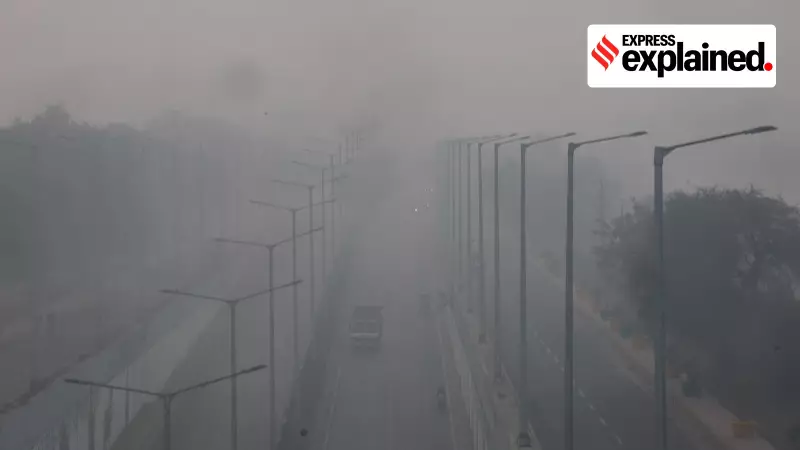
A silent, invisible chemical process in the atmosphere over North India is responsible for a massive share of the toxic air that Delhi's residents are forced to breathe. New analysis reveals that secondary pollutants now constitute at least one-third of the capital's annual PM2.5 load, explaining why air quality can plummet dangerously even when local emission sources seem managed.
The Invisible Culprit: How Secondary Aerosols Form
Unlike primary pollutants like road dust or vehicle exhaust that are emitted directly, secondary particulate matter is born in the sky itself. It forms when precursor gases, released from sources often hundreds of kilometres away, undergo complex chemical reactions influenced by humidity, temperature, and sunlight. These reactions create microscopic particles that can penetrate deep into lung tissue.
The most dominant of these secondary villains in Delhi's air is ammonium sulfate. According to a recent analysis by the Centre for Research on Energy and Clean Air (CREA), this single compound accounts for nearly one-third of Delhi's yearly PM2.5 pollution. Its share rises sharply during the post-monsoon and winter months, precisely when the city experiences its most severe smog episodes.

Coal, Chemistry, and a Cross-Border Threat
The formation of ammonium sulfate is a two-step atmospheric recipe. It starts with sulphur dioxide (SO₂), a gas predominantly released by coal-fired power plants, along with refineries, industries, and diesel combustion. This SO₂ oxidises in the air to form sulfate. The sulfate then reacts with ammonia, which is largely released from agricultural fertilisers, livestock waste, and other sources.
The resulting compound becomes a suspended fine particle that remains airborne for days, travelling vast distances. This makes it a potent driver of transboundary pollution. India is currently the world's largest emitter of SO₂, primarily due to its reliance on coal-based power. In a significant policy move in July 2025, the government exempted nearly 78% of coal-fired plants from installing mandatory flue gas desulphurisation (FGD) systems, a decision experts warn weakens control at the source.
CREA's 2024 satellite data shows the highest annual contribution of ammonium sulfate to PM2.5 is in coal-heavy states like Chhattisgarh (42%), Odisha (41%), Jharkhand, and Telangana (40% each). The problem spans multiple airsheds, affecting Bihar, Uttar Pradesh, Maharashtra, Andhra Pradesh, and West Bengal, with direct implications for Delhi-NCR.
Why Winter Worsens the Crisis and What History Teaches Us
Meteorology plays a critical role in accelerating this chemical factory in the sky. High humidity, fog, and low winter temperatures speed up the reactions, allowing gases to transform into deadly particles within hours. This explains why Delhi's pollution often spikes during stagnant winter conditions without a visible increase in local emissions. CREA notes ammonium sulfate contributes around 49% of PM2.5 in the post-monsoon period and 41% in winter, compared to just 21% in summer.
This phenomenon is not new. The deadly 1948 Donora smog disaster in the US was driven by sulfate aerosols from industrial emissions. Studies from Beijing have shown how concentrations of sulfate, nitrate, and ammonium can multiply four to eight times during severe episodes, driven by similar atmospheric chemistry. Beijing's experience in the late 1990s and early 2000s, when it consumed 42 million tonnes of sulphur-rich coal annually, mirrors India's current challenge.
As Delhi, ranked the world's most polluted national capital in 2024 with an annual PM2.5 average of 91.6 µg/m³, grapples with this crisis, experts are urging a strategic shift. With the National Clean Air Programme (NCAP) up for revision, the focus must expand beyond primary pollutants and PM10 to urgently address the regional formation of secondary aerosols, which are now a defining feature of North India's toxic winters.