

Delhi Government Shortlists 33 Innovative Proposals to Fight Air Pollution
New Delhi is taking a technological approach to combat its persistent air pollution problem. The Delhi government's innovation challenge has identified thirty-three promising proposals that could help clear the city's air. These solutions will be publicly displayed at the Indian Institute of Technology Delhi this Friday.
From Smog Guns to Vehicle Retrofit Systems
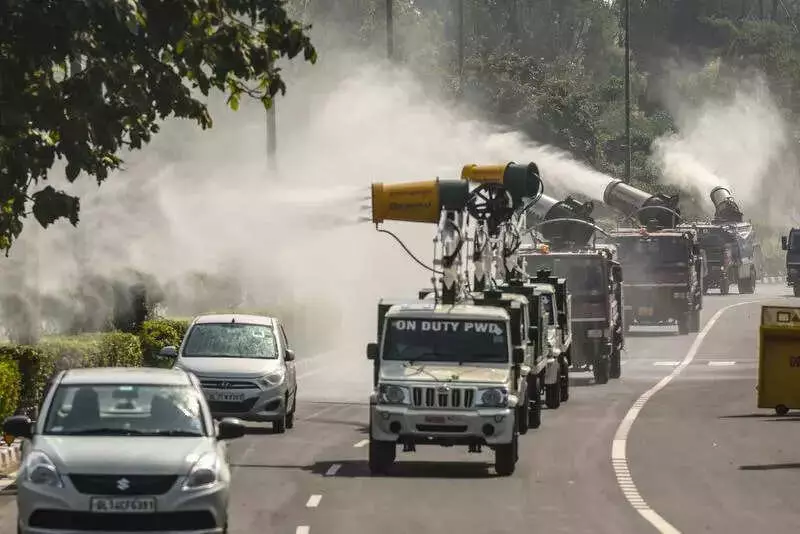
The shortlisted innovations represent creative thinking applied to environmental challenges. Among the proposals are air purifiers designed to mount directly on vehicles. Another interesting concept is a self-activating smog gun that springs into action when particulate matter sensors detect dangerous levels. The list also includes vehicle-based micro dust collectors and retrofit systems that can improve car emission quality.
Other notable innovations scheduled for exhibition include solar-powered pole-mounted dust traps. There is also a bio-alkaline vehicle exhaust scrubber and an advanced system specifically targeting nitrogen oxide emissions control. One device is meant for installation at traffic signals to reduce both particulate matter and harmful gases. Perhaps most intriguing is a vertical wall system using living microalgae to capture carbon dioxide in tight urban spaces.

Rigorous Selection Process Underway
The innovation challenge initially attracted over two hundred applications from across the country. From these, thirty-three proposals made the initial cut for exhibition. However, the real vetting process is just beginning.
An eight-member Internal Technical Evaluation Committee will now examine each proposal thoroughly. This committee is led by Professor Sagnik Dey from IIT Delhi and includes scientists, professors, and anti-pollution experts. Their mandate is clear: identify solutions that are not just innovative but also practical, scalable, and impactful for Delhi's specific conditions.
Delhi Environment Minister Manjinder Singh Sirsa explained the committee's focus areas. "We will select solutions which can be implemented for two categories — reducing ambient air and vehicular emissions," Sirsa stated. He added that final selections would be made by January 31st, with winners receiving awards of five lakh rupees each.
Evaluation Criteria Emphasize Practical Implementation
The selection process involves multiple stages of scrutiny. During primary screening, each entry will be examined against strict eligibility and technical criteria. Those that pass this initial review will then be pitched directly before the Internal Technical Evaluation Committee.
Officials emphasize that evaluation will consider more than just scientific innovation. The committee will specifically assess deployment feasibility in Delhi's unique environment. They will examine how well each solution adapts to local conditions. Cost-effectiveness remains a crucial factor, as does compliance with existing environmental regulations and legal norms.
The committee has clear instructions to prioritize easy-to-maintain, low-cost solutions that can be implemented quickly. This practical approach reflects the urgency of Delhi's air quality crisis.
Incentive Structure for Winning Projects
The Delhi government has established a tiered incentive system to encourage practical solutions. The Delhi Pollution Control Committee will award five lakh rupees per project upon successful evaluation and testing by the Internal Technical Evaluation Committee.
An additional incentive of fifty lakh rupees awaits solutions that receive verification from laboratories equivalent to the National Physical Laboratory. This second tier of funding is specifically reserved for solutions recommended for government adoption after thorough validation.
Selected solutions will undergo field trials before implementation. They will also require permissions from various regulatory agencies. This careful, step-by-step approach ensures that only proven, effective technologies get deployed across the city.
The innovation challenge represents Delhi's latest effort to tackle its notorious air pollution through technological innovation. By combining creative thinking with rigorous evaluation, officials hope to identify solutions that can make a real difference in the city's air quality.






