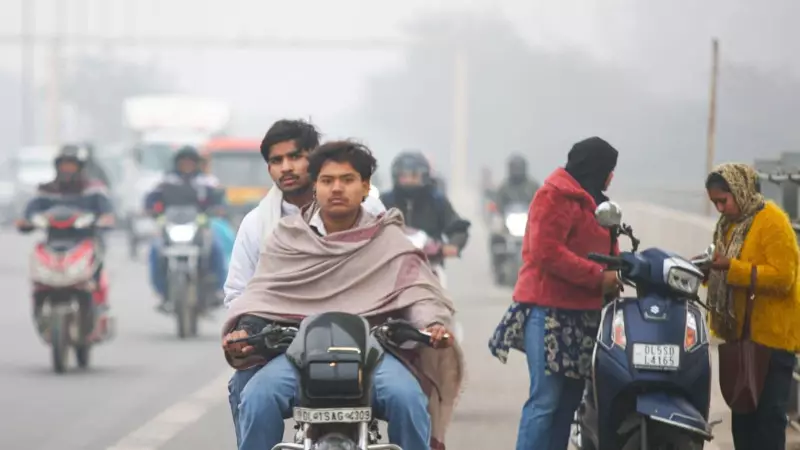
Delhi residents woke up to the chilliest morning of the season on Saturday, as the mercury plunged to a biting 4.2 degrees Celsius. The intense cold spell, accompanied by a thick blanket of fog and persistently hazardous air, has tightened its grip on the National Capital Region, with forecasts predicting little relief in the coming days.
Record Cold and Dense Fog Disrupt Normal Life
According to the India Meteorological Department (IMD), the minimum temperature of 4.2°C recorded on Saturday was approximately three degrees below the seasonal average. This marks the coldest day of the current winter season for the capital. The maximum temperatures also remained subdued, ranging between 17°C and 20°C across the city.
The severe cold was compounded by dense fog, which significantly reduced visibility during the morning hours. Safdarjung, the city's base weather station, recorded visibility as low as 200 metres. Conditions were worse at the Palam area, where visibility dropped to a mere 50 metres, disrupting road and air travel. The IMD has issued a yellow alert for cold wave conditions at isolated places and warned of moderate to dense fog on Sunday and Monday mornings.

Air Quality Stagnates in 'Very Poor' Category
After a brief period of marginal improvement earlier in the week, Delhi's air quality has regressed firmly into the 'Very Poor' category. Data from the Central Pollution Control Board (CPCB) showed that the capital's average Air Quality Index (AQI) was 346 on Saturday, slightly worse than the 345 recorded on Friday.
Neighbouring cities saw minor fluctuations. Noida's AQI showed a slight improvement, dropping from 365 to 348. Similarly, Gurgaon's AQI eased from 373 to 349. Despite these small changes, the air quality across the entire Delhi-NCR region remains a serious health concern.
Unfavourable Weather Conditions to Persist
The forecast for the upcoming week offers little hope for a significant turnaround. Meteorological authorities have indicated that wind speeds are likely to remain below 10 kilometres per hour throughout the coming week. Such calm conditions are highly unfavourable for the dispersal of accumulated air pollutants.
The Air Quality and Weather Bulletin from the Indian Institute of Tropical Meteorology (IITM), Pune, predicts that the air quality will remain in the 'Very Poor' category at least until January 13th, with a similar outlook for the subsequent six days. The ventilation index, a crucial metric for pollutant dispersion, is expected to stay well below the favourable threshold of 6,000 m²/s.
The IMD further forecasts that maximum temperatures will stay below normal until Sunday, while minimum temperatures are likely to remain 1.6°C to 3°C below normal over the next few days. Shallow to moderate fog conditions are expected to persist until January 13th, with very light rain or drizzle possible at isolated locations.
The combination of intense cold, poor air quality, and reduced visibility presents a significant challenge for the city's inhabitants, urging authorities and citizens to take necessary health and safety precautions.