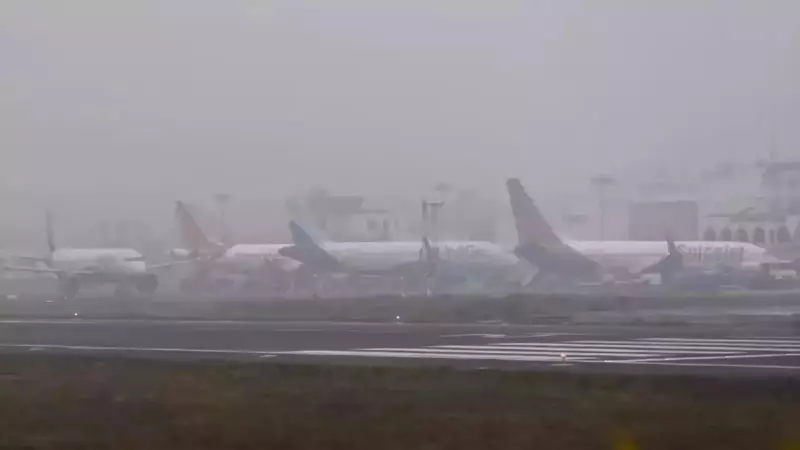
Residents of India's capital were greeted by an intense blanket of fog on Monday morning, marking the season's first severe episode and plunging the city into chaos. Visibility dropped to zero, severely disrupting air and rail travel across northern India.
Airport Operations Grind to a Halt
The Indira Gandhi International (IGI) Airport faced severe disruption as departures were suspended for nearly five hours from 4 am to 9 am. This was due to visibility falling below the safe minimum of 100 metres. The cascading effect of the early morning suspension lasted throughout the day.
Official figures revealed the scale of the disruption: a total of 228 flights were cancelled—131 departures and 97 arrivals. Furthermore, over 800 flights experienced delays, and five were diverted to other airports. Flight tracking data from Flightradar24 indicated that by evening, delays had affected 260 arrivals and 400 departures.

Meteorological Breakdown and Improving Conditions
The India Meteorological Department (IMD) provided a detailed timeline of the fog's intensity. Visibility began dropping sharply on Sunday night, reaching 150 metres by 11:30 pm. By 12:30 am on Monday, the Safdarjung observatory recorded zero visibility, a condition that persisted until 2 am. At Palam, near the airport, visibility plummeted to a mere 50 metres at 4 am.
Relief came only after 9 am, with the sun breaking through. Visibility at Safdarjung improved to 300 metres by 9:30 am and 700 metres by 10:30 am. Similarly, Palam saw visibility rise from 100 metres at 9 am to 500 metres by noon.
Airlines and Ministry Respond to Travel Chaos
The civil aviation ministry acknowledged that dense fog impacted several airports across north India. It advised passengers to contact their airlines, check official apps and websites, and plan for extra travel time. The Director General of Civil Aviation (DGCA) reviewed fog preparedness and instructed officials to monitor passenger inconvenience.
Major airlines issued statements explaining the operational challenges. IndiGo cited severe impact due to "low visibility (below minima)" which was beyond their control, leading to proactive cancellations for safety. Air India also confirmed that poor visibility affected all airlines, resulting in some cancelled flights to avoid prolonged uncertainty for passengers.
The crisis highlighted the difference in pilot training. Only pilots certified for CAT-III procedures can land with a visibility of 50 metres and take off at 125 metres. Pilots without this certification require around 500 metres of visibility, leading to significant delays as they wait on taxiways for clearance.
The ripple effects extended beyond the skies, with at least 100 trains running late across the network, compounding the day's travel woes for thousands.