Delhi's Air Quality Plummets, GRAP-4 Restrictions Reimposed
Authorities in Delhi reinforced stringent anti-pollution measures under the Graded Response Action Plan (GRAP-4) on Saturday. This action followed a sharp deterioration in the national capital's air quality. The Air Quality Index (AQI) breached the 400 mark in several areas, signaling severe pollution levels.
What GRAP-4 Restrictions Mean for Delhi
The revived GRAP-4 curbs impose several immediate restrictions across Delhi and the National Capital Region (NCR). Non-essential trucks face a ban on entering Delhi. All construction and demolition activities must halt. Colleges and educational institutions will close. Offices must implement additional restrictions to curb pollution sources.
Public, municipal, and private offices received an advisory to operate with at least 50% staff working from home. Authorities may introduce staggered office timings to reduce peak-hour traffic congestion and associated emissions.

School Closures in Delhi-NCR: A Lingering Question
Will schools in Delhi and the NCR remain closed on Monday? This question gained urgency with the reimposition of GRAP Stage IV. Schools across the region had previously closed due to cold wave conditions. They were scheduled to reopen during the week of January 16.
The sudden pollution spike and GRAP-4 implementation are prompting authorities to reconsider holding physical classes. This is especially true for younger, more vulnerable students. As of now, there is no official confirmation regarding school closures for Monday. Parents and students are advised to stay informed through direct updates from their school administrations, district authorities, or state government notifications.
In practical terms, GRAP IV mandates a hybrid learning mode for students up to Class V in Delhi and major NCR cities. The plan strongly recommends the same hybrid approach for all classes up to XII.
CAQM's Rationale for Invoking GRAP Stage IV
The Commission for Air Quality Management (CAQM) issued a notification on Saturday explaining its decision. The commission noted Delhi's AQI stood at 400 at 4 PM. It worsened to 428 just four hours later. CAQM attributed this rapid decline to a western disturbance, highly unfavourable meteorological conditions, and a lack of pollutant dispersal.
"Keeping in view the prevailing trend of air quality and relevant factors... the CAQM Sub-Committee on GRAP unanimously decides to invoke all actions under Stage-IV," the notification stated. This 'Severe+' category applies when the Delhi AQI exceeds 450. The CAQM implemented these measures proactively across the entire NCR to prevent further air quality deterioration.
Under the GRAP framework, air quality falls into four stages:
- Poor (AQI 201–300)
- Very Poor (AQI 301–400)
- Severe (AQI 401–450)
- Severe+ (AQI above 450)
Weather Conditions Compound the Crisis
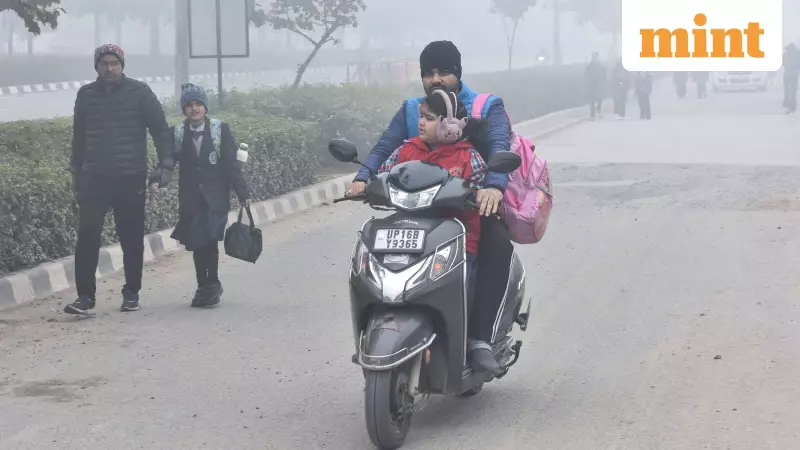
Meanwhile, dense fog enveloped Delhi on Sunday morning, severely reducing visibility. The near-zero visibility disrupted flight operations at the capital's airports.
The India Meteorological Department reported Delhi's minimum temperature on Saturday at 4.4°C. This reading is 3.2 degrees below the seasonal average. Morning hours saw dense fog, while the maximum temperature climbed to 24.6°C. Relative humidity stood at 72 percent by 6 PM.
Meteorologists forecast a gradual temperature rise between January 17 and 20. This period may also bring light winter rainfall. However, residents should prepare for another cold spell expected from January 23 to 26, which could further trap pollutants.